HORROR: JOURNEY THROUGH THE DECADES- 1960’S (1963) – The Birds

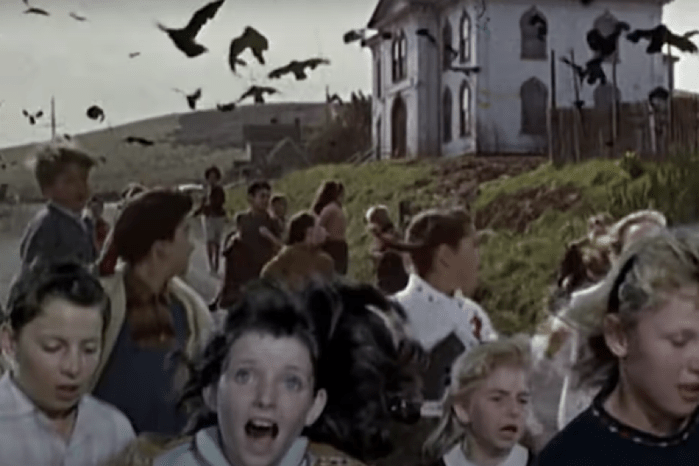
How far would you go for love? For those who currently have someone they’re enamored with, it may be easy for them to say that they’ll go to great lengths. However, how far would you go for someone you know very little about? Love is a complicated emotion and it can make people do crazy things. Alfred Hitchcock’s 1963 horror film, The Birds explores these complexities of love by drawing parallels between the brash behavior of birds and the impulsivity of human relationships. The visual symbolism, carefully crafted dialogue, and natural sound tell a story of the chaos that ensued amidst an avian attack in the 1960s, in a manner that resonates with modern audiences.

The film opens in San Francisco, where gulls are flying around as audiences are introduced to Melanie Daniels, who is scurrying into a bird shop. Her plan is to get a myna bird but things go awry when she meets Mitch Brenner, who recalls her involvement in a court case, and he decides to play a prank on her. Melanie is initially irked by his quick judgment of her, but she is quickly smitten and plans a trip to Bodega Bay to secretly deliver a pair of lovebirds that he wanted for his sister Cathy. The lovebirds become such a pivotal motif throughout the film as they become a symbol of resistance because they stick together amidst all the calamity that unfolds. Melanie is caught in the act of delivering the birds as a gull begins pecking at her when she travels away from Mitch’s home. Interestingly, this isn’t the first time Melanie will be jabbed at, as the town folks are naturally curious about her visit to Mitch and begin to flock over her sudden appearance in their town. Drawing these parallels between the instinctive habits of birds and the curiosity of humans in the affairs of love really sets up the story of what happens when both worlds collide. 
source: Universal Pictures

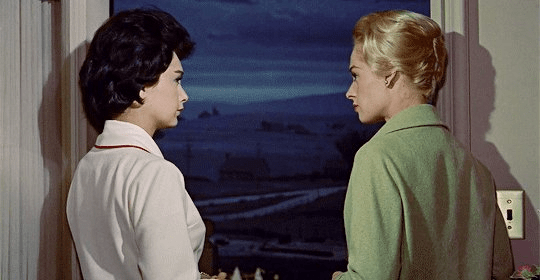
As the story continues, Melanie encounters an array of different characters and the conversions that she has with them gives further insight to their bird-like qualities. For instance, she meets Annie Hayworth, a school teacher who is living a life on her own after a romantic relationship with Mitch ended abruptly because his mother, Lydia Brenner disapproved. Annie tells Melanie that ironically, she and Mitch’s mother became friends now that she “is no longer a threat” to her son. This further explores the bird-like behavior in the affairs of love as the teacher is viewed as a predator, whom Lydia believed would disrupt the stability of her nest. When Melanie finally meets Mitch’s mother, the parallels to avian activity continue as they have a heart to heart. Lydia explains that her family is a “very good reason for getting out of bed”, which emphasizes her devotion to it, much like a mother bird cares for her chicks. The dialogue that the characters exchange with Melanie reinforce the connection between the all consuming nature of human relationships and the predatory and protective habits of birds.

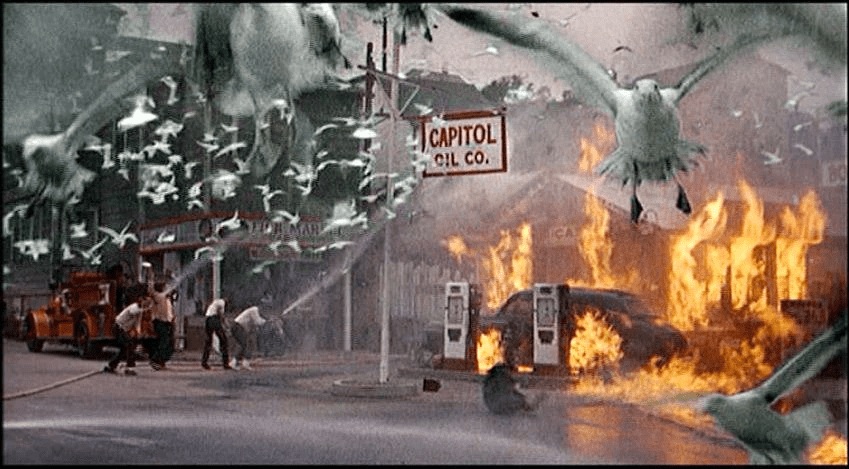
Another intriguing aspect of the film is that it lacks a score and relies on ambient sound to explore the similarities between the aggression of birds and the complexities of humans in the affairs of love. In one key moment, Melanie and Mitch take refuge in a Bodega Bay diner when birds begin to swarm the area. The sounds of the wings flapping and screeching fills the scene and makes those hiding in the diner feel cornered and violated. Interestingly, this is similar to the events that unfold inside the diner where the town’s people verbally target Melanie and blame her for the attack. The bird’s screeches fill the ambience much like the insults envelope Melanie and Mitch. During perhaps the tensest moment of the film, Melanie, Mitch and his family try to escape their home that is surrounded by birds. As the avians’ chirping creates an eerie mood, Cathay’s lovebirds remain silent, drawing perhaps the biggest parallel to human nature. It provides commentary on the fact that much like the birds, humans are invasive in other’s romantic affairs, making them, not the lovers, the loudest disruptors of the peace. 
source: Universal Pictures

The Birds is a unique film that succeeds in exploring the horrors of an avian attack and comparing it to people’s intricate behavior when dealing with matters of love. With its strong symbolism, Hitchcock highlights how the various types of birds represent aspects of human nature such as attraction and curiosity. The dialogue also gives insight to the people’s bird-like qualities when it comes to defending loved one’s because it uses the conversations to shed light on the characters’ protective nature over their flock. The film’s lack of a score solidifies the comparison because just as the twittering of the birds casts an unsettling feeling amongst the town, unsolicited opinions of outsiders may taint the tranquility between a couple.

Despite being released over 60 years ago, The Birds remains relevant because humans are still affected by the convoluted affairs of love, and much like nettlesome birds, it is not something that one day will spontaneously fly away.
Horror: Journey Through the Decades- 2020’s (2022) – Bones and All

MGM

source: MGM

By: Chayliel Quintanilla Flores

“You don’t think that I’m a bad person? “

“All I think is that I love you.”

With these words, two lovers let down their guard and solidify their devotion to one another. However Lee and Maren aren’t an ordinary couple. They’re runaways and living on the outskirts of society. Above all, they’re cannibals. Luca Guadagnino’s Bones and All (2022) adapts Camille DeAngelis’ young adult novel into a film that is a perfect mixture of horror and romance to tell the story of a love that was doomed from the start.

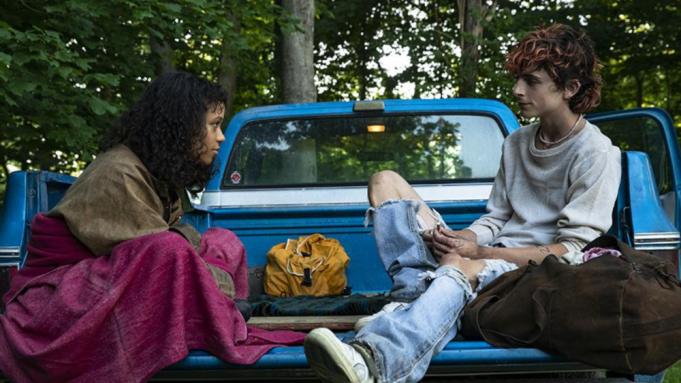
The film, which is set in the Midwest in 1988, opens with a wide shot of Maren, played by Taylor Russell, sitting by herself in a high school auditorium. Maren is always alone, not by choice but because her life circumstances make it difficult for her to make friends. When she is invited to a slumber party, she jumps at the opportunity for a taste of a normal life. However, Maren doesn’t just hunger for human connection; she desires human flesh. It isn’t long until her cravings take over at the expense of the party’s host, and she’s forced to flee to escape judgment. Abandoned by her father, she ventures out on her own to try and find her estranged mother, whom she inherited her unconventional habits from. Maren’s escapade leads her to meet Lee, played by Timothée Chalamet, a fellow “eater” who, like her, is learning to navigate the terrifying and inevitable practice of eating his own kind.

Bones and All is a stylistically beautiful film. While many horror films focus on a dark and somber aesthetic, Guadagnino embraces softer tones even in the characters’ darkest moments. When Lee and Maren share their first conversation, the director uses extreme wide shots to capture the blue and pink hues of the setting sun behind them. Although the conversation is uncomfortable as Maren catches Lee in the aftermath of preying on an insolent man, the framing of the shot brings tenderness to the scene as two lost souls connect for the first time. The visual imagery continues through the consistent use of jump cuts, zoom-ins and shifts in focus as the characters are haunted by the sudden flashbacks of their loved ones who abandoned them. Maren’s father left her to fend for herself, and Lee’s father was abusive, which are memories that continue to plague them, even as they attempt to move forward. Guadagnino’s incorporation of these cinematographic techniques provides a glimpse into the young adults’ traumatic pasts without interrupting the flow of the narrative.

source: MGM

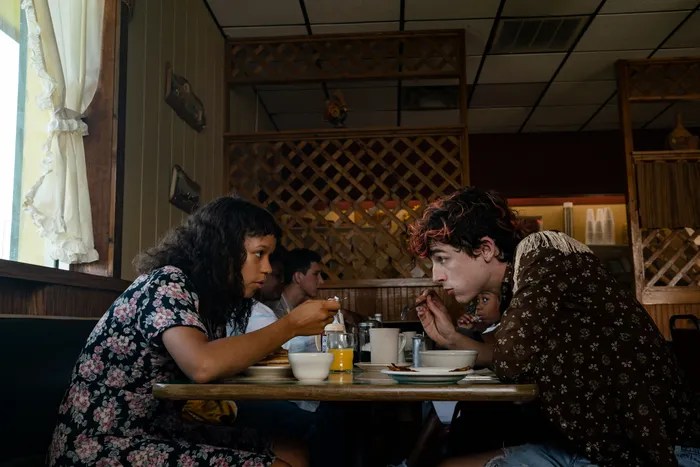
Lee and Maren are complex characters and wardrobe and props also play a large role in giving insight to the intricacies of their personalities. Maren is on a journey to find her mother and wants to remain hidden, so her wardrobe consists of coats and clothes in various shades of somber colors. Until she meets Lee, her only plan is to find out about her mother and not draw attention to herself. Lee on the other hand has somewhat come to terms with being an outcast and embraces it through a both masculine and feminine style consisting of ripped jeans, patterned shirts, and vibrant, red curls. A perfect example of the contrast between Lee and Maren is when they share their first normal meal together at a café. She orders buttermilk pancakes, while much to the surprise of their waitress, he indulges in a bowl of Lucky Charms with a side of bacon and a cup of coffee. Even through these minor details, it is evident Maren wishes to live cautiously while in the public eye while Lee knows he’s different and chooses to embrace it to a certain extent. 

Sound is another crucial element which explores the romance that blossoms between these two young people amidst the environment of the 1980’s. Unlike the eerie scores that horror films tend to implement, Bones and All relies on a light guitar composition along with diegetic sound to deliver Lee and Maren’s story. In one instance, Lee’s rocks out to “Lick It Up” by KISS as they sing “life’s a treat so it’s time you taste it”. Ironically, while the lyrics allude to his unconventional habits, they also serve as a reminder that Lee, like many young adults, finds solace in music. As Maren learns how to drive, George Strait’s “Amarillo by Morning” comes on the radio and Lee sings along to the lyric, “everything that I’ve got is just what I’ve got on” as if to tell her that they’ve got nothing to lose. However, music isn’t the only sound guiding the story as dialogue from televisions and radios demonstrate that society is still revolving outside of the couple’s secluded world. For instance, Maren is moved by a religious sermon on the radio urging listeners to “forgive one another” even when it is difficult, but as Lee reminds her, there is unfortunately no hope for them. After this heavy remark, they sit quietly, proving that silence is equally as powerful in communicating the isolation that Lee and Maren feel in the open landscapes of an unknown world. 

source: MGM

Perhaps the most intriguing aspect of Bones and All is its usage of metaphors. Guadagnino made a name for himself by directing the LGBT film, Call Me By Your Name (2017), his first collaboration with Chalamet, which earned them both critical acclaim. It is interesting to see him approach DeAngelis’ novel from a new lens by using cannibalism to symbolize queer love. Lee and Maren are outcasts, but not by choice. Their unorthodox desires are part of their nature, and must hide them in order to get by in the world, a feeling that many in the LGBT community can resonate with. When Maren eventually finds her mother, she learns that she is in a mental asylum, another nod to the idea that society is afraid of outsiders, so it locks them away. As for Lee, while at one point he seduces a male carnival employee with the goal of luring him in as a meal for Maren, it is never explicitly stated that he is queer. While the implications are there, like many of his unconventional habits, it is not something to be advertising in a midwestern town in the 1980’s.

Bones and All is a story about love and the frightening journey of coming to terms with one’s true self. Through his carefully crafted mise-scene, Gudagnino draws audiences into the complexities of Lee and Maren’s story. While it doesn’t excuse the pair’s actions, the imagery evokes empathy for two characters who are learning to navigate with their inescapable habits. Sound conveys the emotions that words can not, and it humanizes Lee and Maren’s experiences by reminding viewers that despite the couple’s circumstances, they are still enveloped in the noisy world of the 1980’s. The film incorporates clever undertones in order to draw parallels between the ostracizing tendency of eating one’s own kind and the stigma associated with being queer, which is still relevant in the modern day. The real horror of this film doesn’t come from the characters’ cannibalistic habits, rather from the fact that the couple desires to commence a new and normal life together. but society has ways of interfering and ensuring that their newfound comfort is only temporary.

As Lee says, “You want to be people? Let’s be people.”

Knowing it is only a matter of time before the world crashes upon the glimmer of hope they’ve found in one another, Maren responds, “Yeah. Let’s be them for a while.”