Haunt-Tober 2024 Day 6: Re-Animator

Haunt-tober 2024 is here and it’s time to dive into the macabre, the strange and the frightful during this beloved time! Join me as I spend the month discussing new and classic films. 

Between Stuart Gordon’s masterful eye to Jeffrey Combs pitch perfect performance, Re-Animator fires on all cylinders with silly and bloody precision.

This is an H.P. Lovecraft adaptation after all. So, expect a lot of weirdness with your horror. 

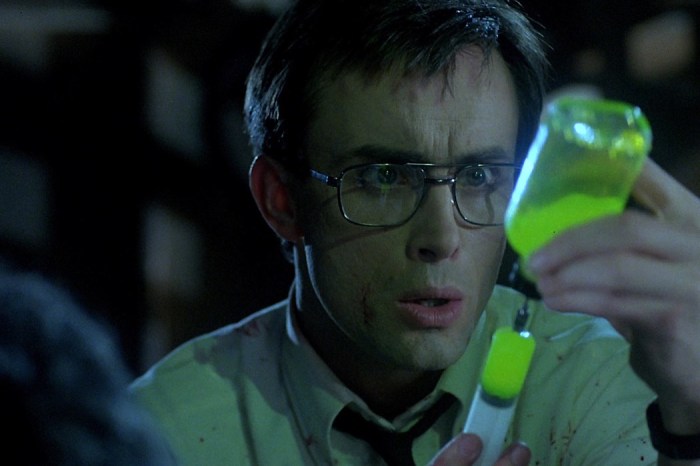
Herbert West (Jeffrey Combs) arrives at University with a reagent that revives the dead, dragging his roommate Dan Cain (Bruce Abbott) into his mayhem. Their experiments escalate when West involves his rival, Dr. Hill (David Gale), and Dan’s girlfriend Meg (Barbara Crampton). 

Of course, no one ever learns – you shouldn’t mess with death! what starts as a genius yet bizarre invention becomes a cluster of bad decisions and even bigger mishaps.

source: Empire Pictures

There is fantastic use of practical effects and some scenes will have you bust out laughing. Combs’ deadpan humor is especially hilarious and there are moments in this film that are so absurd I dare you not to crack a smile.

At a sleek 86 minutes the film is all pulpy playful fun, with little waste. The cast is all great (including scream queen Crampton) but it’s Jeffrey Combs with his intensity and dry delivery that make this so good.

Re-Animator was Stuart Gordon’s first movie and it has an energy that is undeniable. While the plot isn’t particularly inventive there is still a real charm to the mad scientist gone awry formula. It is also executed in a way that makes for an iconic and memorable experience showcasing what makes B horror so lovable.

Re-Animator is zany goodness, with ample splatter and morbid humor that makes for an all time classic. 

Stay tuned for more Haunt-Tober fun!

What do you think? Let us know in the comments below!
Haunt-Tober 2024 Day 5: Salem’s Lot (2024)

Haunt-tober 2024 is here and it’s time to dive into the macabre, the strange and the frightful during this beloved time! Join me as I spend the month discussing new and classic films. 

If you’ve followed my blog you know that I’m a big Stephen King fan. He’s been a huge inspiration for me and whenever I hear of another adaptation (which, let’s be honest, is like very few months), I am excited. Yes, it’s a cautioned excitement but one all the same.

When I heard there was a new Salem’s Lot coming I was intrigued, despite there being two previous versions. The Tobe Hooper is a classic and should definitely be consumed by anyone who hasn’t seen. The other, a much lesser (and underrated) known entry, is the 2004 two-part miniseries by Mikael Salomon

Gary Dauberman’s newest is a poor induction into the pantheon of King adapts. It strips the story down to its fairest point, taking away character development and overall cohesion, until you’re left with a good looking vampire tale that doesn’t feel like Jerusalem’s Lot.

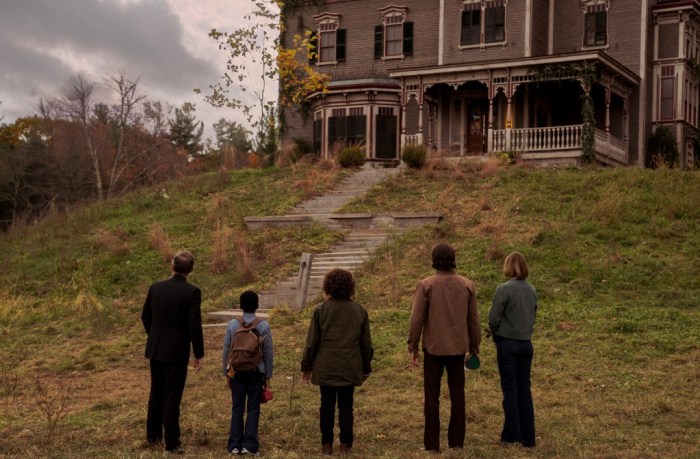
Author Ben Mears (Lewis Pullman) returns back home to Salem’s lot for his newest book. Soon after arriving he becomes involved with aware of a vampire that’s slowly taking over the town.

Along with Pullman, there is Mark Petrie (Jordan Preston Carter), school teacher (Bill Camp) Susan (Makenzie Leigh), local doctor (Alfre Woodard) and priest (John Benjamin Hickey) joining the cause for life.

source: Max

There are aspects I liked. I did love the 70’s aesthetic. There are some great looking and creepy shots. It has a terrific cast, that, with better dialogue and less edited cuts, could have had something good. The creature design is good, but the character of Barlow is empty.

Mears barely feels like a main character and so much of his story (and other character’s) is scrapped. I won’t go into all of the changes from the book, and there are many, because I truly try to look at them separately. But, even as just a new addition to vampire cinema, this is a lean and underwhelming film.

Salem’s Lot is a mediocre adaptation that doesn’t give us anything new to ruminate on. There’s a missed opportunity here that exists as a serviceable vampire film, but doesn’t have anything really exciting to sink your teeth into.

Stay tuned for more Haunt-Tober content!

What do you think? Let me know in the comments below!
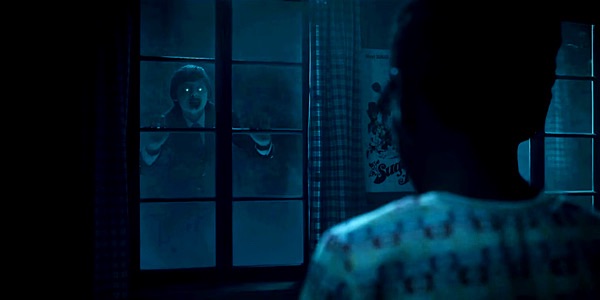
Haunt-Tober 2024 Day 4: Splinter

Haunt-tober 2024 is here and it’s time to dive into the macabre, the strange and the frightful during this beloved time! Join me as I spend the month discussing new and classic films. 

Don’t you love an entertaining jaunt that features a great cast and an even better creature? That’s Splinter.

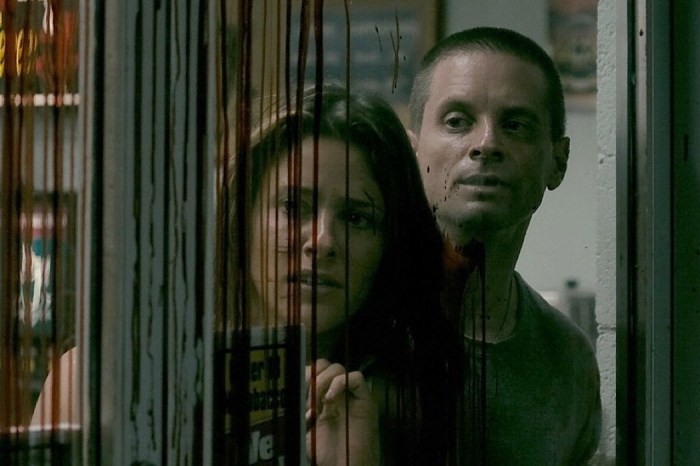
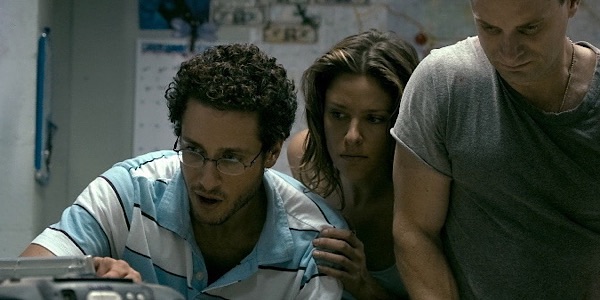
Polly Watt (Jill Wagner) and boyfriend Seth Belzer (Paulo Costanzo) are celebrating their anniversary. When their plans to camp outside change, they decide to check into a motel.

On their way, they’re carjacked and kidnapped by wanted criminal Dennis Farell (Shea Whigham) and Lacey Belisle (Rachel Krebs), who take them to a local gas station. What’s waiting there though, is much worse.

source: Magnolia Pictures

Director Toby Wilkins creates a lively horror that maintains suspense despite its one location setting. These characters, forced to work together despite their differences as something more insidious looks to take them over, are all fascinating and entertaining.

Kai Barry and Ted Kroeber penned the script which incorporates flashes of humor, sweetness and a clear humanity. The cast is excellent and have a rapport that makes it easy to take the journey with them, maneuvering the high stakes and shifting threats.

And as I said, the creature creation is great. A splintering parasitic black goo that spreads over its host and animates it.

Splinter is a treasured gem for me. It doesn’t take itself too seriously but is efficient in capturing its horrific intent.

Stay tuned for more Haunt-Tober!

What do you think? Let me know in the comments!

Haunt-Tober 2024 Day 3: Christine

Haunt-tober 2024 is here and it’s time to dive into the macabre, the strange and the frightful during this beloved time! Join me as I spend the month discussing new and classic films. 

Out of context: a car goes on a killer rampage, sounds ridiculous. In execution, well, it’s still silly, but damn is it a blast.

Combining my two favorite heroes of horror John Carpenter and Stephen King, a fantastic novel is brought to campy demented delight. 

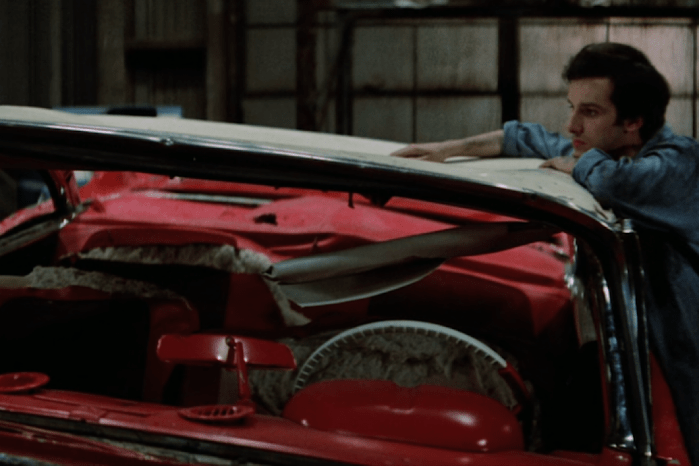
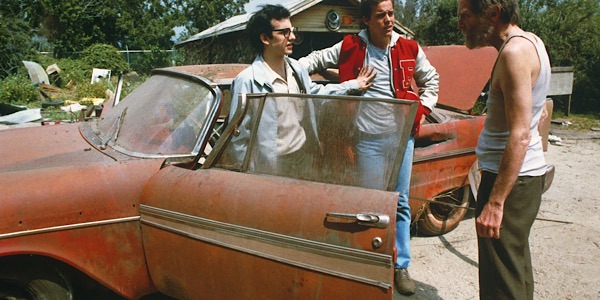
Arnie Cunningham (Keith Gordon), a high school senior, discovers a 1958 Plymouth Fury in a junkyard named Christine and restores it. A bond is immediately formed and he buys her from LeBay (Roberts Blossom). Unbeknownst to him, there’s something sinister at its core and the car soon turns to murderous intent.

Arnie is by no means popular, often overlooked by his overbearing mother Regina (Christine Belford), and bullied by his classmates. His one friend, Dennis (John Stockwell), a popular football player is his real support system. 

source: Columbia Pictures 

As he spends more time with the car, he begins to change, becoming cruel with traits of toxic masculinity. He starts dating Leigh (Alexandra Paul) and both her and Dennis see the transformation, heading warning as Arnie slips from their control. Christine, unlike anything else he has experienced, can restore herself, making her – in some ways – the perfect companion: Resilient and steadfast in her loyalty.

There’s a vibrancy to Christine and a narrative that combines obsession and the need to be seen with the power that comes with achieving it. It’s also a film about high school life and the difficulties that come with growing up.

In the novel, there is more of a possession that takes place. The film takes a slightly different approach though Christine is no less cautionary as a warning for the power hungry. 

The film isn’t by any means Carpenter’s best, but it colors this classic novel with gleeful skill. The cinematography and editing is fantastic, along with a great soundtrack.

Christine is an effective horror that’s tense and entertaining, making it another successful vehicle for the talent involved.

Stay tuned for more Haunt-Tober fun!

What do you think? Let me know!

Horror: Journey Through the Decades 2020s (2021) – Mad God

source: Shudder

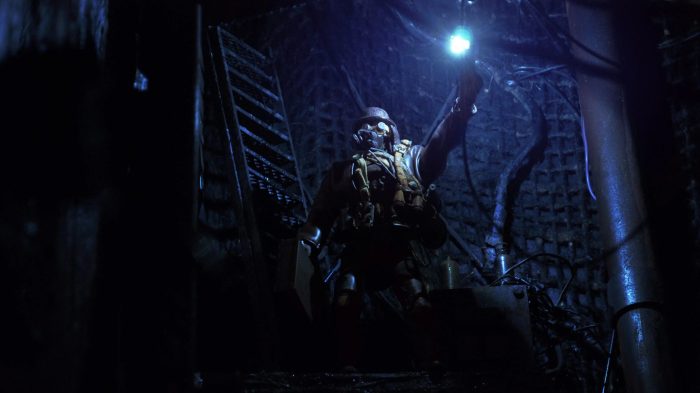
Phil Tippett’s Mad God is inspirational, certainly not due to its subject matter, but because of the context surrounding its creation. Tippett, a virtuoso of stop-motion animation and creature design, revisited designs built over three decades to make this uncompromising, macabre meditation. The project feels like an artifact unearthed from a time capsule, dusted off to unveil a wholly unique aesthetic altogether, one that invites us to appreciate the depraved and the bizarre. 

The film follows an anonymous assassin as he descends deeper into a bleak hell-scape, stunningly crafted out of practical sets and ignited into existence using stop-motion techniques. As the protagonist wades through the landscape of blood, pus, grime, and murk, we truly marvel at what practical effects can accomplish in this genre, bringing to life the gory and the grotesque in ways that CGI cannot. Tippet brings the best type of world-building to his project—the kind where there is no map or compass, and worlds seem to exist within worlds, like a living, breathing fractal artwork. Completely devoid of the spatial awareness we naturally crave, it’s up to the dark recesses of our minds to make meaning out of every bump in the night and to try to understand the laws that govern this peculiar land.

source: Shudder

Each frame of Mad God is an entire world in itself—detailed, grueling, and strange. Every moment is so visually captivating that attention shifts quickly, creating a viewing experience that leaves us remarkably arrested in the present moment. Like a twisted haunted house, there’s no time to fully process what you’ve just seen; before you know it, you’re compelled to move to the next room, where another horror awaits. This makes piecing together a linear narrative an impossibility, but that’s okay because there isn’t one to be had anyway. Strange creatures inhabit every scene. Some are slaves to others. Some are eaten by others. Some are killed by others for ritual or sport. We witness life for a moment, then death for a moment, and then ultimately move to the next frame, leaving these monsters in the abyss.

Tippet somehow creates an ecosystem where each object, living or not, is crafted with such care and intention, yet is so utterly disposable at the same time. This dichotomy reflects a point that could be made about our own existence, offering some thought-provoking, existential musings of a nihilistic variety. While Tippet is the mad god of his own weird world, he might argue that our god is just as mad. Even in its abstractness, the film tells a tale of life and death, growth and destruction, depicting the human race negatively—as ill-fated, destined to repeat the same mistakes of war, pollution, and consumerism over and over. Cynical, sure, so how does it manage to be so moving? For the creative in all of us, it stirs something deep within. There is inherent beauty in listening to a singer sing or watching a dancer dance. Whatever your thing is, this artistic achievement inspires you to go do it. Phil Tippet’s thing is bringing creatures to life through stop-motion animation, and Mad God exists as a rare gift—the gift of a person creating exactly what they were meant to in this life.

Destroy All Neighbors Giveaway!

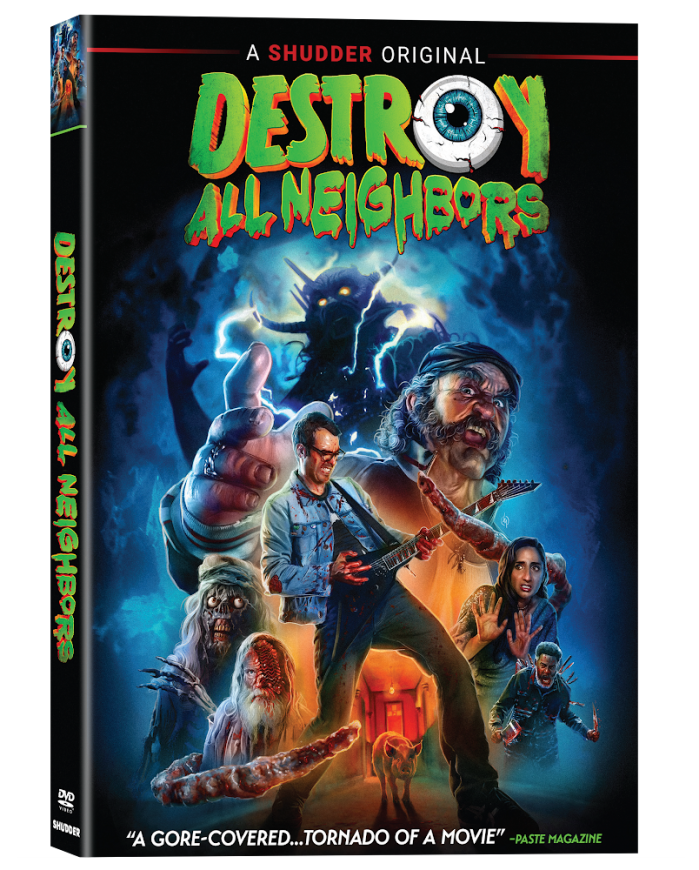
Enter for a chance to win one of three Destroy all Neighbors dvds!

The horror movie is described as “a twisted splatter-comedy about a deranged journey of self-discovery,  full of goopy practical FX, a well-known ensemble cast, and LOTS of blood. “Struggling prog-rock musician William Brown finds himself in a living nightmare when he accidentally  kills Vlad, the neighbor from hell.”

Enter here and share on social media to qualify!

Giveaway will run for two weeks!

Horror: Journey Through the Decades- 1970s (1976) – The Omen

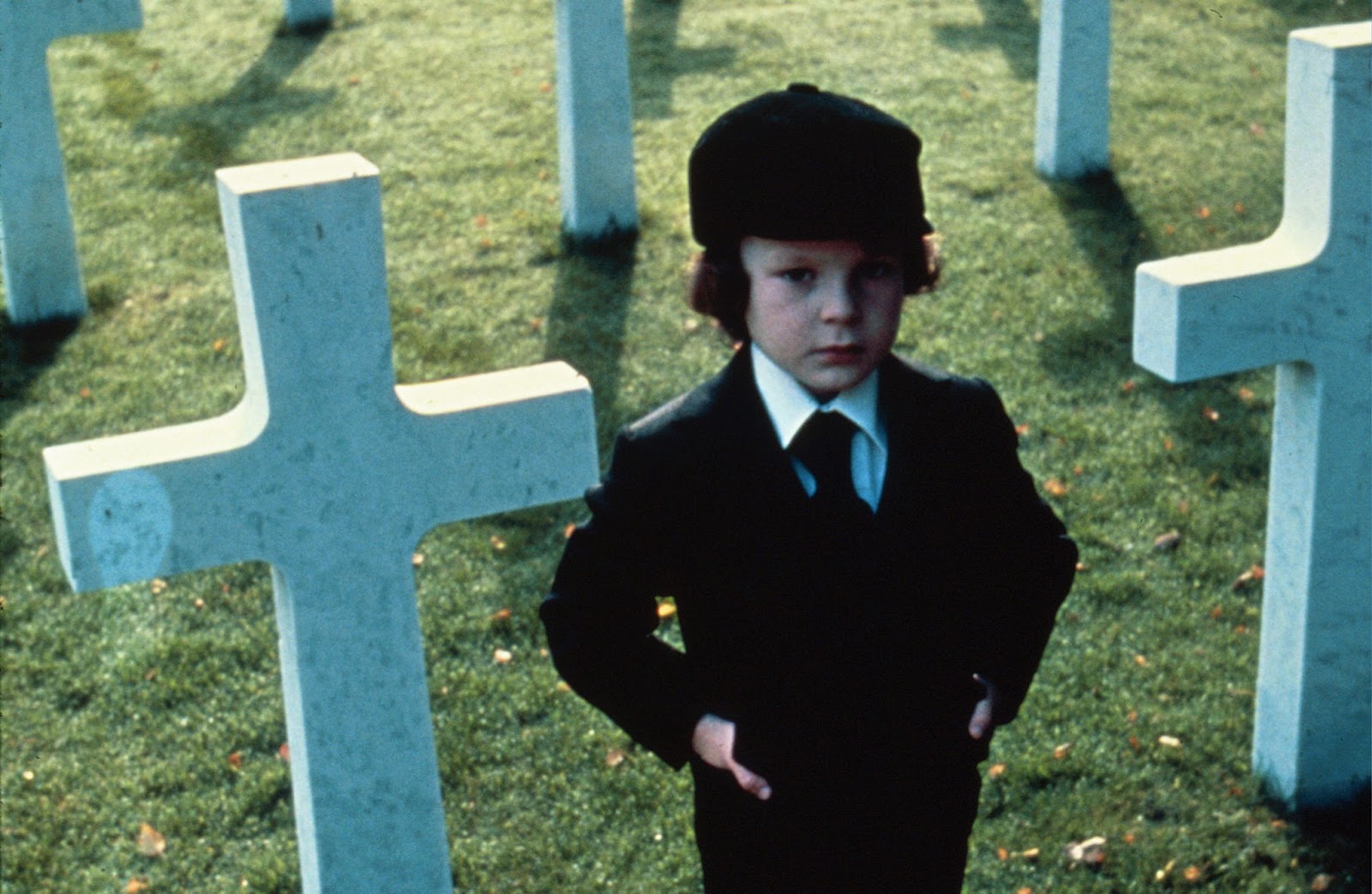
From Rosemary’s Baby to The Exorcist to Children of the Corn, the archetype of the evil or possessed child has been an evident part of the horror genre. Richard Donner’s 1976 horror classic, The Omen, is also famous for its evil child, the Son of Satan. However, the character of Damien Thorn in The Omen, stands apart from these other popular demonic children. 

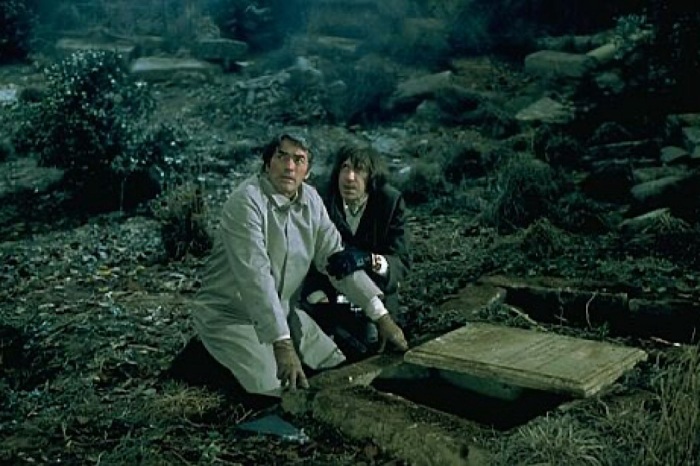
In the film, after Katherine Thorn (Lee Remick) delivers a stillborn baby at the hospital, her husband Robert (Gregory Peck) adopts a young baby boy unbeknownst to his wife. As their son Damien begins to grow older, a series of mysterious deaths and events begin to follow the Thorn family. A priest, Father Brennan, reveals to Robert that Damien is the son of Satan, the Antichrist. He also reveals that Katherine is pregnant and Damien will kill her new child, along with both Katherine and Robert. As more people around the family begin to die, Robert investigates the true background of Damien while coming face to face with evil. 

Source: Turner Classic Movies

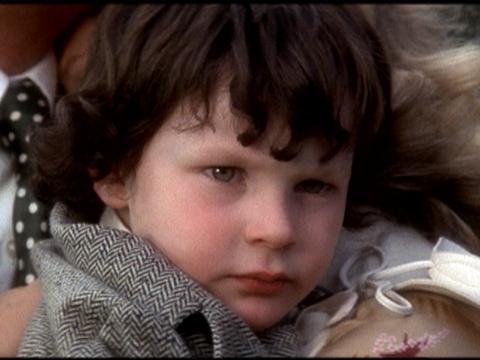
Growing up, I always loved The Omen and the character of Damien Thorn. I found him to be such a different character compared to the other evil children depicted in horror movies. With little dialogue and simple stares, he could capture my attention in a second. And although Damien screams and physically attacks his mother at the sight of a Espicopal church and has tantrums typical of a young boy, he embodies a quiet villainy that is as haunting as it is compelling. Throughout the entirety of The Omen, Damien hardly says any other words besides “mommy” and “daddy”. His mere presence keeps viewers on edge. 

In The Exorcist, the character of Regan MacNeil represents a more overt and visceral form of possession. Regan’s transformation from a young girl to a vessel for demonic forces is physically and emotionally intense, with dramatic changes in her appearance, behavior, and language. Similarly, in Children of the Corn the monstrous children of Gatlin are depicted as the primary antagonists. Led by Isaac and his subordinate Malachai, the children capture and brutally murder adults in the town and put them on crosses as human sacrifices. Characters such as Regan and Isaac openly display their monstrous nature and are vocal about their violent intentions.

Source: Turner Classic Movies

In one scene in The Omen, Katherine decides to take Damien on a visit to the zoo. As the mother-son duo strolls and drives through the park, they encounter an array of different kinds of animals. However, with just a mere gaze at the giraffes, Damien sends all of them running away with fright. The unsettling power of Damien becomes even more apparent when he looks at a large group of baboons only to have them become increasingly agitated. The baboons storm the Thorn’s car while screeching and pounding at the windows. 

In another scene, Katherine is tending to one of her ceiling plants by standing on an uneven table a little too close to the railing. The scene repeatedly cuts back between shots of Katherine, her son Damien riding a tricycle around his bedroom, and the malevolent facial expressions of Mrs. Baylock, Damien’s nanny. Mrs. Baylock opens the door to Damien’s room, enabling him to ride straight down the hallway towards Katherine. Damien rides his tricycle directly into Katherine, pushing her over the railing. Damien purposely attempts to kill his mother. Yet, he never says a word. As he rides his tricycle, the film masterfully plays on the concept of the “demonic child,” subverting traditional perceptions of childhood innocence. He casts only a gaze at his mother as she hangs from the indoor balcony. 

Coming after the successes of The Exorcist and Rosemary’s Baby, as well as being one of the first representations of a demonic child in the horror genre, the character of Damien Thorn captivated audiences with his chilling portrayal of evil incarnate. His sinister presence and subtle actions left an indelible mark on viewers, cementing his status as an iconic figure in a genre that loves its creepy children. 

Silent Night, Deadly Night Novel Review

A monster in the garb of holiday merriment, Billy Chapman (Robert Brian Wilson) slashes his way through 1984’s Silent Night, Deadly Night.

This cult classic among horror fans was as controversial as it was gory and gratuitous. Naturally, this gift seemed destined to be opened when considering a novelization.

And now, your Christmas wishes have come to fruition because the Board gaming experts at Stop the Killer bring the holiday slasher back to life with bloody details from author Armando Muñoz. How much deeper can this holiday horror go? Open the pages to find a new look at the classic film. It’s grisly goodness is the book you didn’t know you needed.

But you do.

Christmas

We begin with Christmas Joy, the Utah town that Billy grows up in. A place brimming with Yuletide wishes year-round. The novel helps to incur discomfort right away, showing the layered web of experiences that caused this madman to be born and shaped and how his *naughty* intentions were nurtured.

While the movie was a sampling of a holiday massacre, this is a full-course meal. It comes with all of the disturbing fixings and plenty of new recipes based on and inspired by the classic film.

Armando Muñoz wields his weapons well, utilizing the violent narrative littered with the evil we know while introducing us to the ones we don’t.

It feels like the film, including the specificity of exact scenes and dialogue. Yet, there’s more violence, more sexual material, and it’s dressed in a decidedly darker shade of red.

source: Tristar Pictures

All of the additions feel at home here. He has done extensive research and taken careful consideration when penning this version of his Santa.

Has arrived

We get further examination of characters, allowing us darker looks that only a novel representation could allow, including Mother Superior. She’s a villain herself, and the book provides ample opportunity for us to learn and be disgusted by the character.

Many plot points are fleshed out, and some of the less coherent script problems are ironed into a much smoother trajectory. And, of course, this includes even more murder!

It’s as if this novelization is the film we wanted but didn’t get. An evenly-paced, aptly salacious story that doesn’t feel rushed. Its depravity is unmatched, and it drives the reader to discover how unhinged Billy and company can become.

Tonally, Armando Muñoz gives a retelling that matches the movie. Through twisted invention, the book succeeds in becoming its own sort of nightmare. One that fans of Silent Night, Deadly Night, will proudly embrace. Those who are unaware of the film but love some deviance with their cheer will also be pleasantly pleased. This is a horror book you can devour regardless of your previous fandom.

Bolder and bloodier: Silent Night, Deadly Night the novel is a Christmas gift you’ll be too afraid to return.

And you wouldn’t want to; it’s a fantastically wicked read.

The eBook will be released on March 1st. For more information on this and the other offerings from Stop the Killer click here.

HORROR: JOURNEY THROUGH THE DECADES- 1960’S (1963) – The Birds

How far would you go for love? For those who currently have someone they’re enamored with, it may be easy for them to say that they’ll go to great lengths. However, how far would you go for someone you know very little about? Love is a complicated emotion and it can make people do crazy things. Alfred Hitchcock’s 1963 horror film, The Birds explores these complexities of love by drawing parallels between the brash behavior of birds and the impulsivity of human relationships. The visual symbolism, carefully crafted dialogue, and natural sound tell a story of the chaos that ensued amidst an avian attack in the 1960s, in a manner that resonates with modern audiences.

The film opens in San Francisco, where gulls are flying around as audiences are introduced to Melanie Daniels, who is scurrying into a bird shop. Her plan is to get a myna bird but things go awry when she meets Mitch Brenner, who recalls her involvement in a court case, and he decides to play a prank on her. Melanie is initially irked by his quick judgment of her, but she is quickly smitten and plans a trip to Bodega Bay to secretly deliver a pair of lovebirds that he wanted for his sister Cathy. The lovebirds become such a pivotal motif throughout the film as they become a symbol of resistance because they stick together amidst all the calamity that unfolds. Melanie is caught in the act of delivering the birds as a gull begins pecking at her when she travels away from Mitch’s home. Interestingly, this isn’t the first time Melanie will be jabbed at, as the town folks are naturally curious about her visit to Mitch and begin to flock over her sudden appearance in their town. Drawing these parallels between the instinctive habits of birds and the curiosity of humans in the affairs of love really sets up the story of what happens when both worlds collide. 

source: Universal Pictures

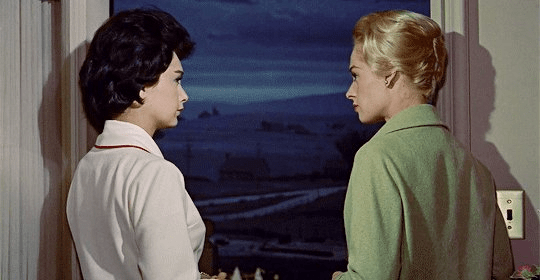
As the story continues, Melanie encounters an array of different characters and the conversions that she has with them gives further insight to their bird-like qualities. For instance, she meets Annie Hayworth, a school teacher who is living a life on her own after a romantic relationship with Mitch ended abruptly because his mother, Lydia Brenner disapproved. Annie tells Melanie that ironically, she and Mitch’s mother became friends now that she “is no longer a threat” to her son. This further explores the bird-like behavior in the affairs of love as the teacher is viewed as a predator, whom Lydia believed would disrupt the stability of her nest. When Melanie finally meets Mitch’s mother, the parallels to avian activity continue as they have a heart to heart. Lydia explains that her family is a “very good reason for getting out of bed”, which emphasizes her devotion to it, much like a mother bird cares for her chicks. The dialogue that the characters exchange with Melanie reinforce the connection between the all consuming nature of human relationships and the predatory and protective habits of birds.

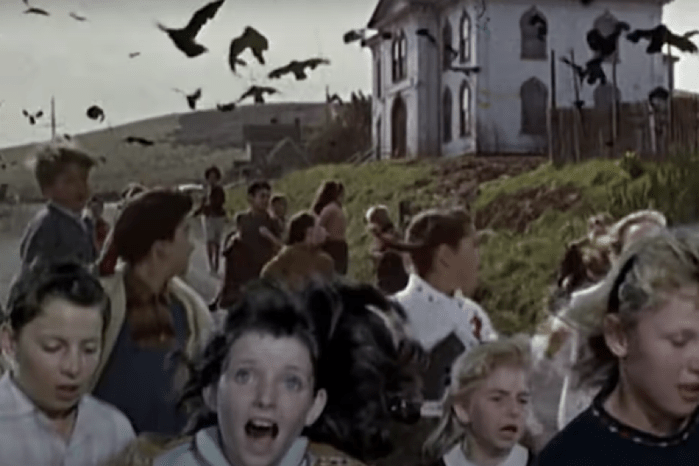
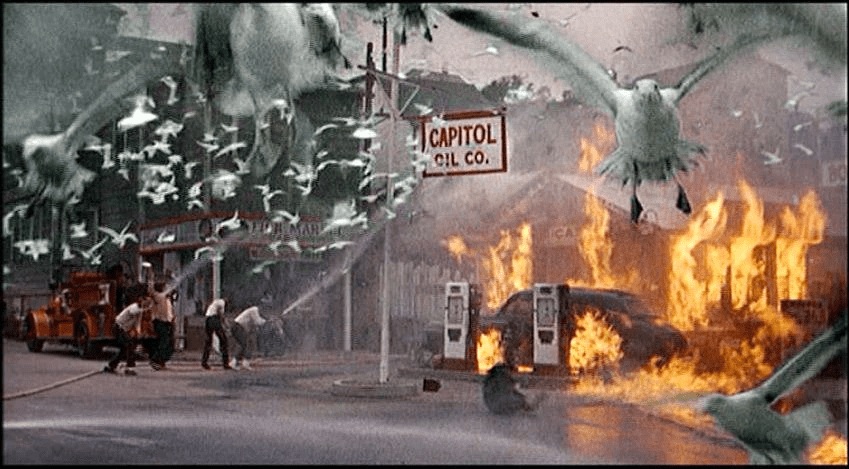
Another intriguing aspect of the film is that it lacks a score and relies on ambient sound to explore the similarities between the aggression of birds and the complexities of humans in the affairs of love. In one key moment, Melanie and Mitch take refuge in a Bodega Bay diner when birds begin to swarm the area. The sounds of the wings flapping and screeching fills the scene and makes those hiding in the diner feel cornered and violated. Interestingly, this is similar to the events that unfold inside the diner where the town’s people verbally target Melanie and blame her for the attack. The bird’s screeches fill the ambience much like the insults envelope Melanie and Mitch. During perhaps the tensest moment of the film, Melanie, Mitch and his family try to escape their home that is surrounded by birds. As the avians’ chirping creates an eerie mood, Cathay’s lovebirds remain silent, drawing perhaps the biggest parallel to human nature. It provides commentary on the fact that much like the birds, humans are invasive in other’s romantic affairs, making them, not the lovers, the loudest disruptors of the peace. 

source: Universal Pictures

The Birds is a unique film that succeeds in exploring the horrors of an avian attack and comparing it to people’s intricate behavior when dealing with matters of love. With its strong symbolism, Hitchcock highlights how the various types of birds represent aspects of human nature such as attraction and curiosity. The dialogue also gives insight to the people’s bird-like qualities when it comes to defending loved one’s because it uses the conversations to shed light on the characters’ protective nature over their flock. The film’s lack of a score solidifies the comparison because just as the twittering of the birds casts an unsettling feeling amongst the town, unsolicited opinions of outsiders may taint the tranquility between a couple.

Despite being released over 60 years ago, The Birds remains relevant because humans are still affected by the convoluted affairs of love, and much like nettlesome birds, it is not something that one day will spontaneously fly away.

Horror: Journey Through the Decades- 2000s (2004) – Saw 

Are you here because you’ve seen Saw? Or because you’re curious to learn more? Whether you’ve witnessed the interwoven narrative of this 2004 American horror film or merely heard about it, you likely know about Saw and its association with violence, gore, and “torture porn.” This term, “torture porn”, refers to films that prioritize brutal and gratuitous images of people getting tortured or killed on screen. Various critics frequently utilize this term to discredit horror films, labeling them as lacking substance and reducing them to nothing more than sadistic narratives.

In a 2007 New York Times article, Jeannette Catsoulis called the first Saw film an “unexpected success” and described the whole franchise as “distasteful” due to its visceral and intense sequences. While not every film caters to everyone’s taste, particularly when it comes to horror, I believe some individuals dismiss and disregard films like Saw due to intense content. These discourses not only discourage viewers from actually watching the movie but also from critically analyzing and engaging with the film’s content. 

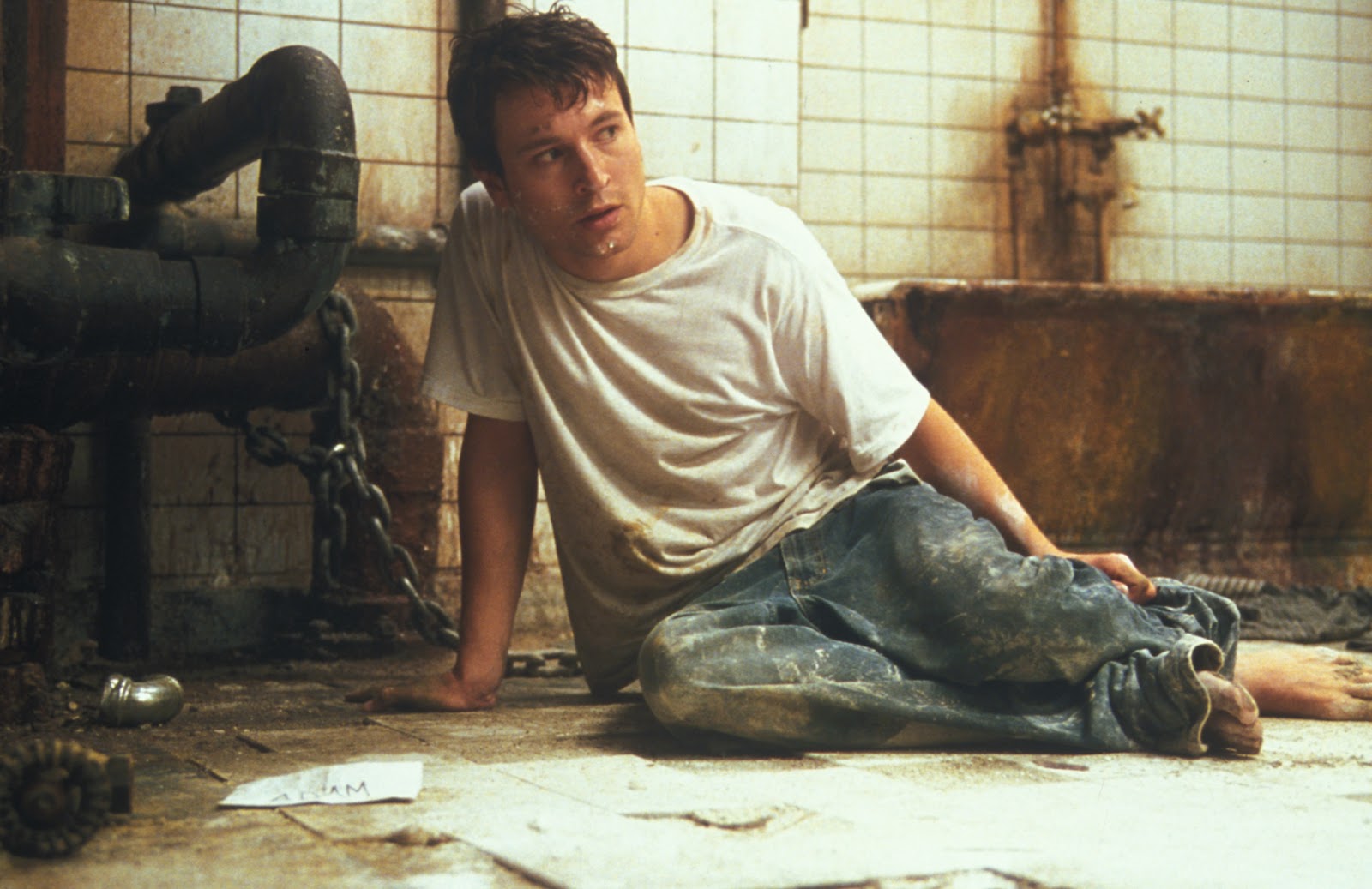
The film, directed by James Wan, begins when two strangers Adam Stanheight (Leigh Whannell) and Lawrence Gordon (Cary Elwes) find themselves chained to the pipes at opposite ends of a dirty and blood-stained bathroom. As the two men attempt to piece together their final moments before being trapped in the bathroom and attempting to seek an escape, the film cleverly weaves in flashbacks delving into the lives of Adam, Lawrence, and past victims. Simultaneously, it intertwines these events with the current investigation into the notorious Jigsaw killer. 

source: Lionsgate

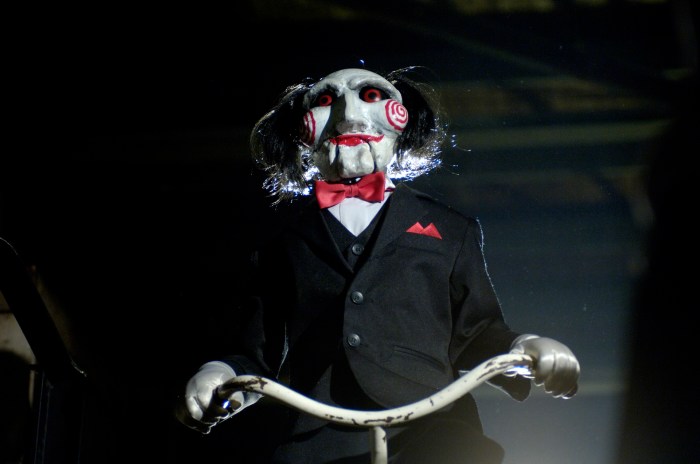
Central to the film’s brilliance is the character of Jigsaw, also known as John Kramer (Tobin Bell). Jigsaw isn’t a conventional villain driven by malice or the desire to kill. He operates on a twisted moral compass to make individuals appreciate life’s value. His traps and games aren’t just sadistic displays of power; they’re an attempt to confront his victims with their flaws and make them rethink the harm they have caused in the past. Although Jigsaw has minimal screen time, his absence only adds to his presence. Viewers, along with investigators, must piece together the clues to discover Jigsaw’s identity and motives. 

While the term “torture porn” looms in media discussions, Saw defies this one-dimensional categorization. Although Saw includes scenes of violence and blood and many of the later films within the franchise include more gore with the introduction of intricate Jigsaw traps, the first film is not consumed by graphic images. Instead, it intricately balances tension with its exploration of moral ambiguity and the psychological depth that sets it apart from mere shock value.

source: Lionsgate

Among fans, Saw is also known for its intertwining narratives and surprising plot twists. In the final moments of the film, the seemingly lifeless corpse that has lay in the middle of the bathroom for the entirety of the runtime slowly comes to life. It is revealed that the body is John Kramer, the real Jigsaw Killer, who “likes to book himself front-row seats to his own sick little games.” The impact of this twist extends far beyond the immediate shock and elevates Saw beyond just a violent and torture-filled flick. It makes viewers rethink everything they just watched, wondering what clues they either caught or missed. It is a moment that remains in viewers’ minds long after the credits roll.

The Saw franchise stands as a milestone in the horror genre, as it is one of the highest-grossing horror series of all time. Saw X, the 10th installment in the franchise, was also released in September of 2023. With these accolades, it is safe to say that many people love the first Saw film and the whole series. If there’s hesitation about watching Saw, give it a chance. It might defy your expectations and leave you contemplating its twists, memorable characters, moral situations, and iconic theme song.