Haunt-tober 2024 is here and it’s time to dive into the macabre, the strange and the frightful during this beloved time! Join me as I spend the month discussing new and classic films.
As a fan of Saint Maud I was really looking forward to her second feature. And, well, Rose Glass you slay me.
The film has sat with me and grown in favor with time and contemplation. What started as a stylish admiration has become a beloved favorite of 2024.
This pulpy thriller is firing on all cylinders with bloody shots and larger than life imagery.
And Ed Harris eats a bug. There’s that too.
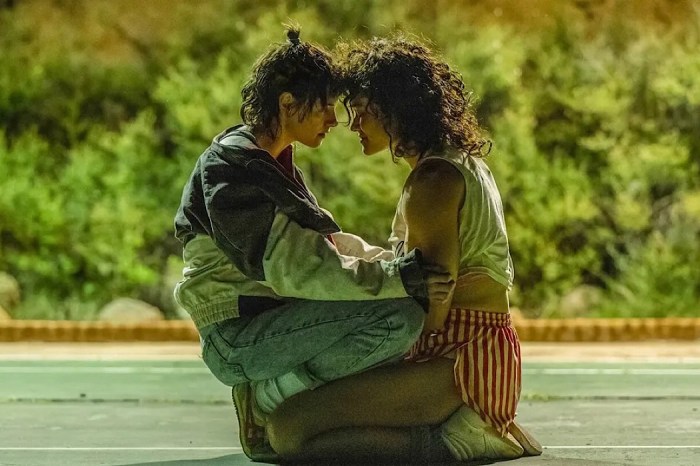
Love Lies Bleeding is a combustive thriller that showcases its talented stars and expert direction. The costume and production design set a compelling stage for this romantic, violent tale to unravel.
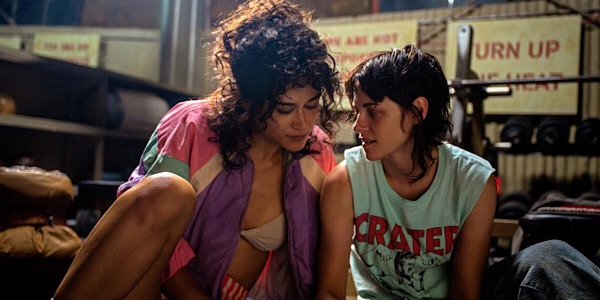
Lou (Kristen Stewart) runs a small gym in a “seemingly” sleepy town. Her sister Beth (Jena Malone) is married to the violent JJ (James Franco) and she has an estranged relationship with her father Lou Sr (the always exceptional Ed Harris). When committed bodybuilder Jackie (Katy O’Brian) shows up, and their fiery courtship begins, tragedy and revenge eventually ensue. This raw but might I even say – cheeky- flick sings at a register all its own.
source: A24
There is a captivating quality about Love Lies Bleeding that doesn’t waver and keeps itself tantalizingly alluring.
While the movie itself is provocative and gritty, thrilling and sexy, one would be hard pressed to say it holds anything back: yet I still felt the film had its secrets, its smirks, and winks. Its ending is sure to be polarizing, but feels at home here.
It happens to be one of my favorite Kristen Stewart performances because I feel there’s an unrelenting power to her character. She commands the screen, but never feels unsure or restrained. I loved that for her. Katy O’Brian is equally talented with a turn that goes through an intriguing metamorphosis. These two are magnetic with ample chemistry.
It has noir inspirations, feels like Thelma and Louise at times, and yet also feels very much like its own. A challenging conceit to capture on film these days. There’s also some body horror images that’ll stick with you.
Love Lies Bleeding is brazingly edgy. It feels like escape, like that rare intimacy, and the lengths some will go for love.
The passion in the film is felt in every beat. Not just as a call for more queer fronted stories, but within the filmmaking itself. A visceral entry, Glass has signified her place as one of the most exciting and unique filmmakers working today.
Stay tuned for more Haunt-Tober!
What did you think? Let me know in the comments below!
Run, Baby, Run doesn’t break the mold when it comes to modern-day thrillers, but it certainly rushes full speed ahead.
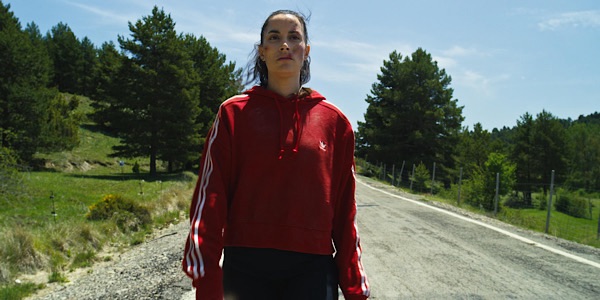
The film follows Diana (Catutxa Leira), a young deaf woman setting out for an outdoor run. Things seem relatively harmless until a mysterious hooded runner races by. From their initial bump on a running path, competition arises between the two, eventually evolving into a fight for survival.
Director Toni Andújar‘s film is brimming with intensity. From its onset to its final act, the film has little opportunity to slow down. It truly feels as if it’s a race against time.
source: Tricoast Worldwide
It’s a script with very limited dialogue and one that relies on its action-intense plot and physical suspense. It utilizes high-pressure moments brought to life by a captivating and energetic synth-based score. There are times when the music becomes too much, but it brings the film’s pulse to a demanding fever, as unrelenting as the story (and antagonist) themselves. The stakes continue to be raised and the lengths that Diana has to go to to live increase in size and danger. While others become involved and things move off the beaten path, the film never loses focus of the two battling at the center.
Some occasionally strange angles bewilder, along with some unnecessary shifts in the plot, but overall, it captures nature beautifully, and human nature, terrifyingly. The action scenes and cinematography are all staggeringly done in such a way that it feels as if we are there with her.
I wish we could have gotten more background (though we do have some telling flashbacks) with Diana, but so much of the film is built around this experience and we learn about her as she discovers her will to survive. Run, Baby, Run doesn’t shy away from being strange with intriguingly unique branching-off points as the plot is propelled forward. This is certainly a film that roars with female ferocity and it’s a call I was excited to hear.
One can admire Toni Andújar for the bold way that this film is tackled. It’s a sprawling set piece that traverses a lot of ground. It doesn’t relent; with little given in terms of a reprieve. While it doesn’t always stick the landings, some genuine scenes of distress are laden within a film carried by its lead performance. Overall, Run, Baby, Run is the little thriller that could: ambitious and enthralling.
The great storytelling advantage of horror as a genre is the inherent feeling of inevitability. Even the most banal scenes are presented in a context of dread. Something horrible must occur to somebody at some point, or else “horror” would not properly describe the events of the story. Most horror films draw attention to this inevitability through cheap tricks, such as not-so-vague foreshadowing dialogue or creepy music laid over useless scenes. Predominately, these tricks are used to tide over the bloodthirsty audience and fill up the first and second acts, eventually arriving at the exciting finale we all showed up to see. Building a story in such a way can feel quite perfunctory.
It was this very critique that led me away from horror in the last few years. The patterns of the genre had become too obvious, and their variations had lost charm. My rather simplistic perspective would be shattered after viewing George Sluizer’s The Vanishing (1988), a film about a young woman named Saskia who goes missing and her husband who would do anything to find her. The film is particularly famous for its ending, but I would like to look at its opening scenes as I feel they present the genre’s necessary sense of inevitability in a new and haunting way.
source: MGS Film
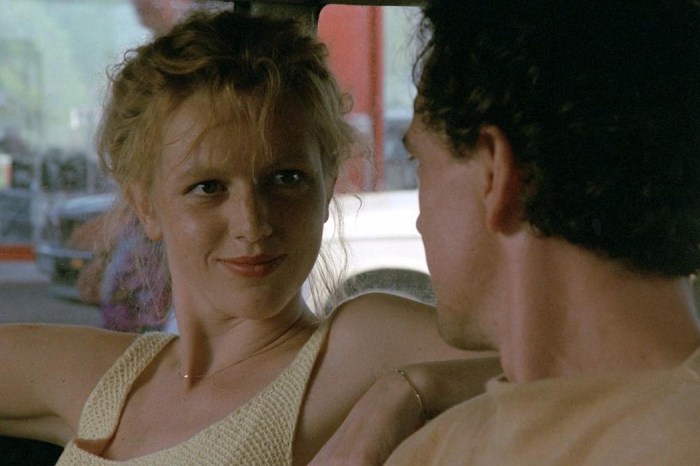
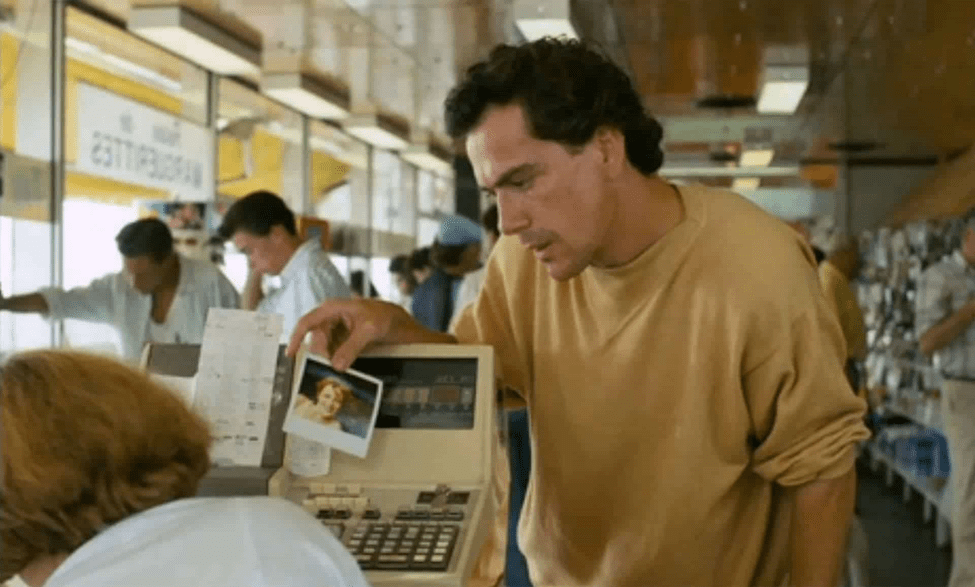
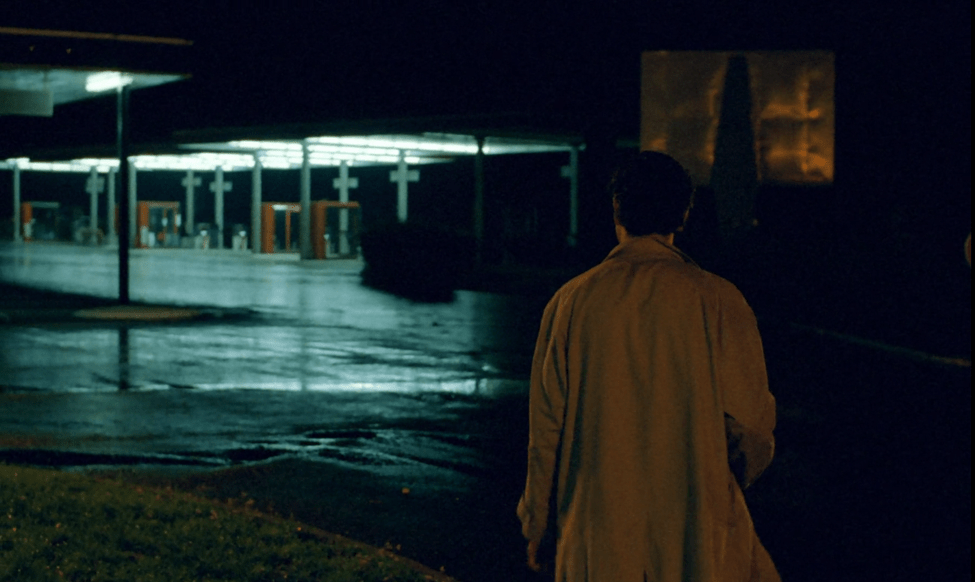
The Vanishing follows a young couple, Rex and Saskia, as they travel cross country on vacation. While passing through a long and dark tunnel, their car runs out of gas. Rex rushes off with a canister to a nearby gas station and leaves Saskia all alone. It seemed obvious that Rex would return to discover his wife had been abducted. Indeed, when he comes back with the gas, Saskia is gone. He fills the car up, drives forward, and… finds her waiting for him outside the tunnel. She is perfectly fine.
source: MGS Film
My intuition had been wrong. I had initially felt relief at seeing her safe, but a moment later, I was terrified. The relief I felt only emphasized the horrific fate that awaited this young, beautiful, and innocent woman. Before, I looked at her disappearance as a function of the plot. Now, every second with Saskia from this point on felt like being with a ghost.
Also, this subversion of expectations prevented me from retreating into the safety of my recognition of storytelling patterns. Sluizer does not subvert expectations with a bold swing, but rather, he does so in an off-the-nose way which causes me to feel a true sense of helplessness. I saw no way to stop Saskia’s abduction because there was no way to know when, why, or even if it took place. It is much harder to identify, and therefore prevent, danger when the situation feels so intangible.
Sluizer does the same trick a second time. After the couple arrives at a rest stop, Saskia goes to use the restroom. A strange-looking man wearing a cast seems to follow her into the building, and we are forced to wait with Rex for his wife’s return. Saskia does return, further teasing her eventual abduction.
As Rex and Saskia prepare to continue their road trip, she goes back into the rest stop one last time. She is never seen again.
source: MGS Film
The structure of this opening made me highly empathetic to Rex. Horror protagonists tend to have a bad reputation for being unintelligent. We all get frustrated when Laurie Strode throws the knife to the side after incapacitating Michael in Halloween. I always shout, “He’s just going to get right back up.” It is a comfortable thing to do. I can escape my fear by believing that I would act more rationally than the characters, and therefore survive a similar event. In The Vanishing, Rex did not take action to stop the abduction because he was unaware of any threat, and I was not able to create a theoretical course of action to stop the abduction because I could not tell when a threat was present or not. He and I may have been on opposite sides of the spectrum, but we were both too distracted to prevent tragedy.
The Vanishing certainly delivers on the essential feeling of inevitability that all great horror films have, but it is its combination with unpredictability that makes me defenseless as a viewer. Inevitability and unpredictability seem contradictory, but it is the careful balancing of both that makes this film one of the most psychologically unnerving ever made.
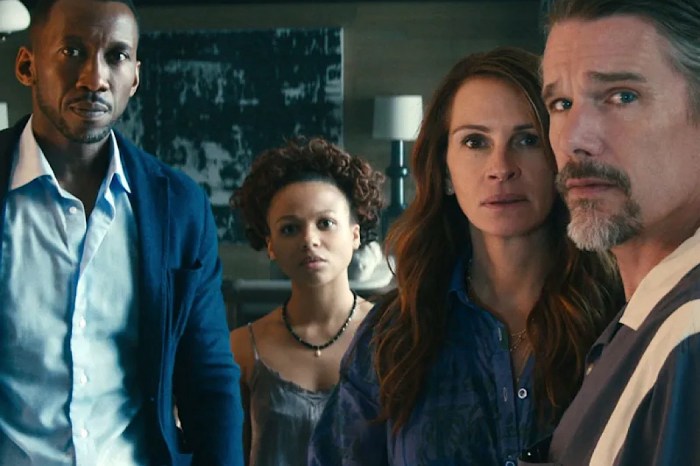
Crafting a haunting thriller that ruthlessly intertwines shock and despair is an art, and Leave the World Behind revels in this with admirable finesse. The film plunges into the abyss of universal fears, weaving them seamlessly into the fabric of a real-world cataclysm. The stellar ensemble, led by Julia Roberts, Ethan Hawke, and Mahershala Ali, adds a layer of brilliance to a narrative that’s both mesmerizing and emotionally scorching.
Initially draped in the guise of simplicity and innocence—a family seeking solace on a Long Island getaway—the narrative swiftly morphs into a heart-rending suspense tale. Trapped and entangled in the dangerous forces at play, the characters grapple with an unforgiving reality.
At first, it’s a blackout, but what starts as something explainable turns into something much worse.
In the chaos, the seemingly content couple, Amanda (Julia Roberts) and Clay (Ethan Hawke), navigate the labyrinth of uncertainty with their children, Rosie (Farrah Mackenzie) and Archie (Charlie Evans). The looming specter of a cyberattack injects an additional layer of complexity, entangling everyone in a web of confusion where answers elude and questions suffocate. Unwanted guests, George (Mahershala Ali) and his daughter, Ruth (Myha’la Herrold) add to a dilemma: trust or escape? Intentions and assumptions are meticulously considered, exposing the raw nerve of human desperation.
Director Sam Esmail masterfully captures the raw agony of in-the-moment hysteria, plunging the audience into a tumultuous sea of emotions. The performances of Roberts, Hawke, and Ali not only mirror the gravity of the situation but catapult it to thrilling heights. The screenplay, rife with grim possibilities, keeps us teetering on the edge, questioning the unfolding events with a sense of impending doom.
The best aspect of the film truly emanates from the interplay of characters. The script by Rumaan Alam and Sam Esmail allows our lead performances to cut deep, their scenes together a manifestation of intriguing depth, an alliance born out of necessity amid the suffocating circumstances. Kevin Bacon also has a key scene in a vital supporting role.
This film perches itself on a throne of despair, thrills, and biting satire, existing in multiple corners of darkness. Sam Esmail is known for his meticulous approach to visual storytelling, and he employs a range of techniques to immerse the audience in the unsettling atmosphere of the film.
The dynamic is woven with understanding, and eventually trust, providing a fleeting semblance of sincerity in the relentless insanity of circumstances that continue to present themselves: strange animal behavior, misbehaving Teslas, and endangering noises: oh my.
Long takes and other movements infuse fluidity into the storytelling, immersing the audience in the characters’ experiences. The cinematography, a potent storyteller, vividly conveys the raw emotions on screen.
The lighting is key too, as it shapes the film’s vibe, mirroring the journey from blissful ignorance to harsh reality. The interplay of shadows during the family’s getaway and eerie artificial lighting in the face of the unknown heightens the overall sense of disquiet.
source: Netflix
The framing is both intimate and purposeful, revealing subtle emotional shifts, while wide shots emphasize characters’ isolation and vulnerability amidst an inexplicable threat.
The icky factor shouldn’t be overlooked either, as some genuinely disturbing, discomforting moments won’t soon leave you as the credits roll. This one has a built-in effect as time has continued on, convincing me it’s a movie that needed to be experienced more than just described. I loved seeing these talented actors take on this intriguing task of a film, which made it even more enjoyable.
Within the film’s editing is a tension-building masterclass, seamlessly bouncing between calm and chaos. Leave the World Behind not only shocks and awes but also leaves an indelible mark with its storytelling, performances that haunt, and the lingering uncertainty that outlasts the rolling credits. It’s visually arresting, nostalgically tuned, and manipulates our emotions as if we’re drowning in our own despair.
Yet, it feels off-kilter, refusing to pay a particular homage to its characters amidst the face of the impossible—an intentional choice that leaves a bitter taste. It doesn’t detach from the effect, as the pacing ensures that eyes are continually glued to the screen.
The film does boast one of my favorite final shots of the year, ending in a way that offers a flicker of hope when the darkness seems insurmountable. The power of Leave the World Behind doesn’t dissipate; it lingers, a haunting echo that refuses to fade away.
“I’ll be there for you.”
Sometimes, we just need some friends.
Leave the World Behind is now streaming on Netflix.
The midnight section of the Tribeca Film Festival is always a place for adventure. It’s one I escape to fondly and with open arms as it frequently allows for some interesting creative dives, and showcases genre-bending curiosities.
It also gives first-time directors such as Hugo Ruíz, the opportunity to present a bold vision, as with his film on this year’s slate:One Night With Adela. It’s got bravado in its positioning and angered temperament that will prove to be wholly divisive among viewers.
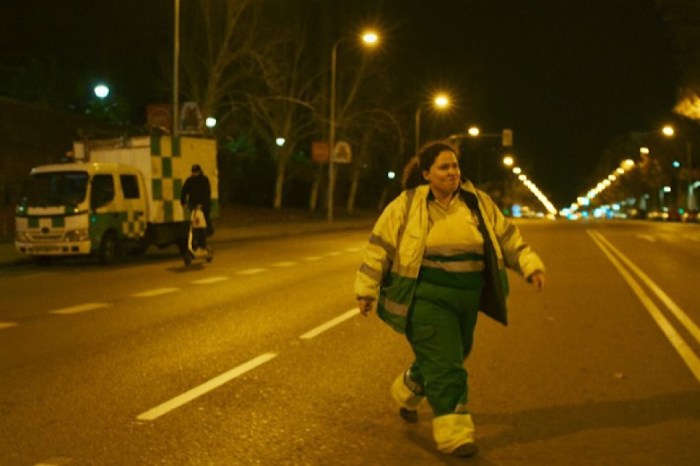
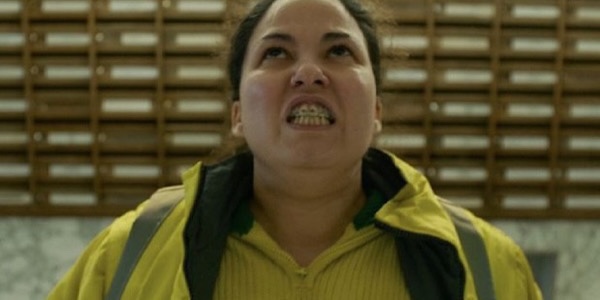
Set in Madrid in real time and edited as one shot, we ride with street sweeper Adela (Laura Galán) as she releases a vengeful pursuit of the city. She calls into a nightly radio show as Ariel, where she admits to the host that she intends to inflict pain, but how and why is yet to be seen.
Her motives or backstory aren’t clear in the beginning, but her rage is palpable. What culminates is a mix of drugs, violence, and sex that tests the viewer’s patience and constitution.
Laura Galán is fantastic. Coming off of another similarly paced, (but much clearer in its intentions) film, Piggy, the actress again commits and truly embodies Adela. She captivates as much as she infuriates but she never lets her command of the camera falter.
“A Human Wreck.”
The choice to film Adela as one long shot over the course of a whirlwind of a night is a stylistic choice that mostly pays off. Aesthetically, the movie strives to match the woe of our lead with the backdrop of a sullen and desperate city in the throes of late night.
source: Tribeca Film Festival
There are some intriguing moments and clever vehicles for tension building such as a scene where the camera stays fixed on a television set while a nature show talks about cuckoo birds, and Adela moves around off-screen. Unsure of what she is up to, unease permeates.
Each encounter speaks a warning, and when a shocking reveal occurs it effectively lives in your stomach.
The final sequence becomes too much of a monologue and while it provides some insight that shows her actions aren’t random but premeditated, it removes some of the previous, slowly built agony that we join her for. It adds some distinction, but it doesn’t necessarily add a lot of depth. In a way, I preferred the uncertainty.
I felt conflicted throughout the movie, often wondering if I admired or admonished some of the choices. In the end, it was both. By no means a perfect film, laden with miscalculations, I couldn’t get Galán out of my mind. Something tells me that’s exactly what Adela would want.
An ambitious project and dizzying bewilderment of excess and impulsivity, One Night With Adela may not have an entirely winning hand, but it goes all in.
One Night With Adelapremiered at the 2023 Tribeca Film Festival.
Welcome to Cinematic Nightmare Candy. Providing your horror sweet toothits (hopefully) terrifying fix.
For this Cinematic Nightmare Candy, I catch up with two films with festival origins, one from 2020 and one from this year. Each are fairly short, with their own flair and full of savage delights.
Becky (Jonathan Milott & Cary Murnion)
source: Quiver Distribution
With the sequel coming out soon, it seemed time to dig into this violent foray!
Becky (Lulu Wilson) is a stubborn, grieving teen who doesn’t make it easy for her father (Joel Mchale) when he takes her and their two dogs to a remote cabin to spend some quality time.
To make things worse, he doesn’t let Becky know when he invites his girlfriend Kayla (Amanda Brugel) and Kayla’s young son Ty (Isaiah Rockcliffe). What starts off as an awkward familial situation quickly turns dire, when the worst situation imaginable becomes a nightmare.
While relationship discord spikes, escaped convicts and white supremacists Dominick (Kevin James), Apex (Robert Maillet), Cole (Ryan McDonald), and Hammond (James McDougall), show up in search of a mysterious key. What the Key is or does remains a secret, but this group is willing to do whatever it takes to find it.
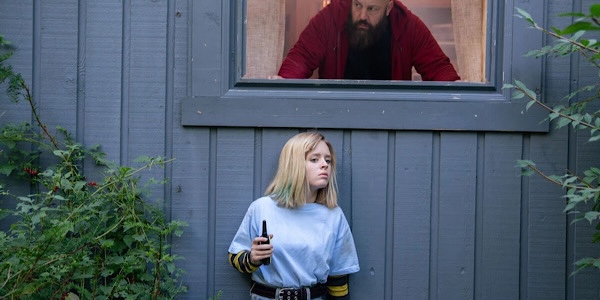
They take the family hostage, but Becky, having retreated to her childhood hideout, is on the loose. When she realizes what’s happening, the anger that she’s carefully held deep down is released in a fury of blood and vengeance.
In other words: don’t fuck with Becky.
The Key to Carnage
They underestimate the scrappy 13-year-old at every brutal turn, and she makes their mistakes, fatal.
Kevin James is quite convincing as the menacing lead villain. It’s a funny, vicious turn for the commonly portrayed family man. Their rapport makes for some interesting comedic moments and biting scenes of disarray. One in particular, with the cutting off of a dislocated eyeball, will have you squirm.
For its simple premise, Becky has a lot of meat on its bones. With elaborate kills and resourceful survival skills, this young badass doesn’t shy away from a cumulation of assaults. The fast pace bodes well as this home invasion premise becomes an intelligently written and vicious tale of vengeance.
Becky is by no means a horror/thriller that lives in reality or seems entirely original, but the revelry imbued in its core makes it a worthy watch. With a terrific lead performance and an overall energetic mood, there’s more than meets the eye.
Evil Dead Rises (Lee Cronin)
source: Warner Bros. Pictures
Evil Dead Rise, the newest of the franchise, hopes to connect a built-in fan base with new horror lovers. While it doesn’t quite reach the epic commune of horror and comedy as its predecessors, it has some fun and deliciously twisted shocks.
I admire what the film set out to do. It aims to carry the torch, but also add some new, gory flames.
This focuses more on family. Facing an upcoming eviction, Ellie (Alyssa Sutherland) and her three children are visited by her younger sister Beth (Lily Sullivan). Beth is a music technician who, after discovering she’s pregnant decides to visit.
Evil Dead Rise teases a cabin-lake story but instead settles into an apartment building that’s on the verge of being destroyed. The inhabitants come across a vault that contains some ancient, insidious text.
“I gotta kill the creepy crawlies that I got inside my tummy.”
Lee Cronin brings some new context to the story but doesn’t utilize it as much I had hoped. What transpires is an adrenaline rush, to be sure, and will undoubtedly please most looking for an onslaught of deaths and disturbing visuals. I admire the decision to shift the locale and I think it has shining elements that showcase creativity. If I separate myself from my love for the previous entries, I can appreciate this horror for its disturbing take.
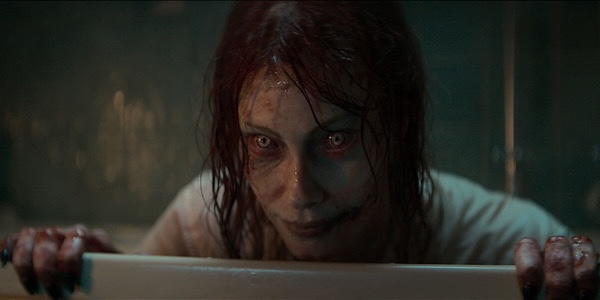
Alyssa Sutherland‘s Ellie and her performance as the misery-loving deadite is one of my favorite aspects. She has some killer lines and distorted moves, which are increased by the limited space and isolated apartment floor.
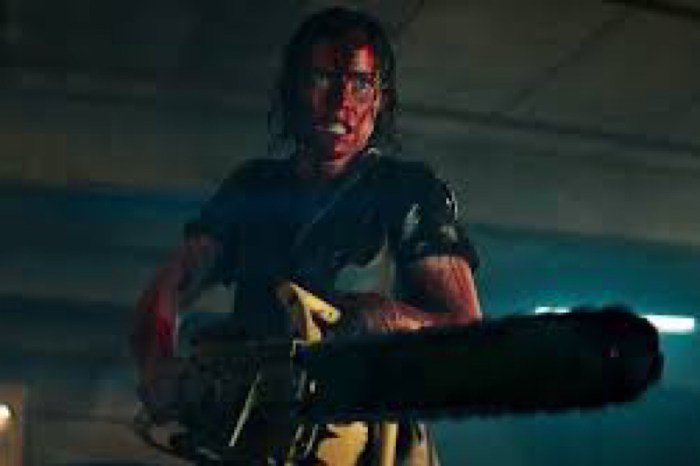
There’s no shortage of chaos or kills, or blood. Some characters seem like fodder and don’t have much depth. While others garner more screen time, but still aren’t as fully fleshed out as one would hope. Flesh though, there’s plenty. It also features some throwbacks to the originals, including a voice cameo from Bruce Campbell and a showing of the versatility of a chainsaw.
If you have a weak stomach or are faint at heart, most likely you won’t be tuning in. It veers into disgusting as often as it can. While sadistic and amusing, pacing issues stifle some of the enjoyment of watching one of the worst family reunions on screen.
After an opening that effectively sets the tone, the film takes a few plotted steps back. The creepiness is shelved for gory exploits. A real misstep was the lack of the campy humor that the originals had in spades. There are moments of humor entwined with entrails and special effects, but it feels at odds with the other serious tones. The camera work is impressive, but even that is eventually ratcheted up to a frenzy.
Evil Dead Rises is a formidable yuck-fest which some tricks up its bloody sleeves, but it doesn’t quite nail the groovy nature of its predecessors.
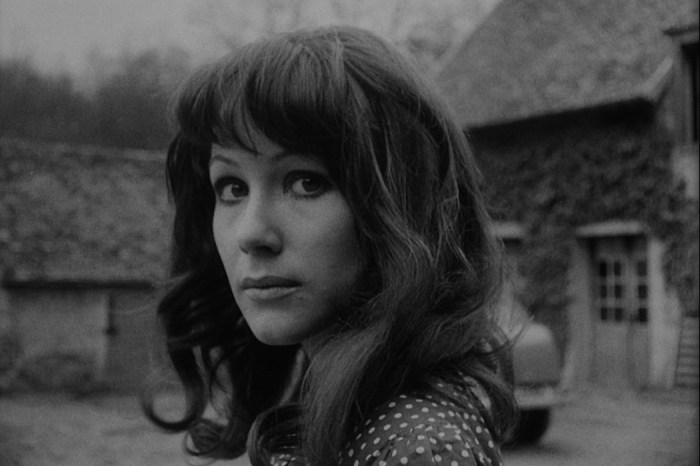
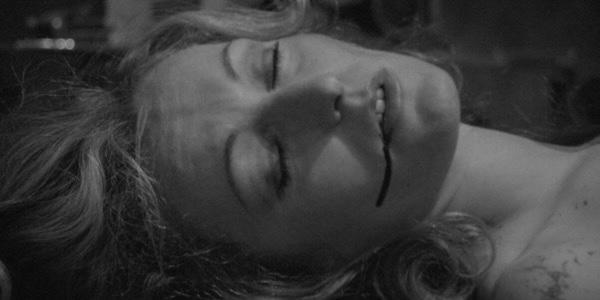
Restored by Radiance films, written and directed by Jean-Denis Bonan, and emerging over 40 years later, A Woman Kills is a stylish and gritty French new wave noir that taunts and disturbs in equal measure.
The city is at unease as prostitutes are being found murdered in a similar fashion to crimes already seen. But, serial killer Hélène Picard has already been caught and executed. Is it a copycat?
source: Radiance Films
It follows investigating officer Solange (Solange Pradel) who is having a relationship with the strange, executioner Louis Guilbeau (Claude Merlin). With his regaling of executions, mysterious Louis gives off a twisted vibe from the onset, but as the film unfolds, we see how far that goes.
A Woman Kills feels psychological, social and political. It encapsulates the era and the strife of the time. The film feels unencumbered by one defined genre, instead burgeoning into a unique hybrid that feels procedural and experimental simultaneously.
The Psyche of a Killer
With narration (Bernard Letrou) that feels calculated and indifferent, and camerawork that aims for claustrophobic and dizzying, one of the most memorable elements of A Woman Kills is its unyielding presence. Monochromic filming and genre blending make it a unique presence in cinematic history.
The unsettling songs written by Daniel Leloux add an intriguing layer to an already unnerving jazzy score. With a temperament that’s Avant Garde yet borders on imperceptible at times, the film carries itself boldly and confident which makes the feat admirable, especially for 1968.
source: Radiance Films
Any disconnected or disjointedness that it suffers from further invokes curiosity. The film’s format, which is odd to say the least, plays like a series of distorted snapshots that infuriates and unbalances the audience.
As a surreal portrait it still holds onto a tangible embodiment, simmering with the strife of the May 68 movement. The historical discord is felt in each step, while the music and narration orchestrate a discomforting journey. Visually and sonically, A Women Kills is masterful. It’s got wry commentary that marries words and images to alluring effect.
The work of cinematographer Gérard de Battista is playfully bleak, following the victims through the street like a documentary. It pairs well with the 68 minute runtime and never over stays its welcome. A Woman Kills chooses visual prowess over narrative substance, with the mystery weak in comparison to the presence of its visage.
While it draws comparisons to other French New Wave films of the time, as well as masters of psychological horrors like Hitchcock, A Woman Kills paves its own path.
I would have loved to have seen more of Solange Pradel, who was compelling but didn’t get enough screen time. Otherwise, the acting works, even if some of the plot points don’t always click as some of the choices, including the “reveal” haven’t aged well.
Despite any narrative concerns, a perceived lack of confidence in the script, and perhaps a product of the controversy and dismay of the time, I was hooked. A Woman Kills was tucked away for many decades and in ways, it has become crystallized.
There’s a beauty in the madness that makes this bizarre piece resonate. A Woman Kills is a bold undertaking, and it’s worth discovering.
Alright, beasties. It’s that time of year again. For this edition of Haunt-tober, I’m going to do a post a day but, like a great haul after trick or treating, I’m hoping to mix it up and deliver some surprises. There’ll be reviews, new or old, seen/unseen, TV or film. Depending on my wicked mood, there may also be lists, audio, or video. I hope you’ll enjoy it and remember: stay weird.
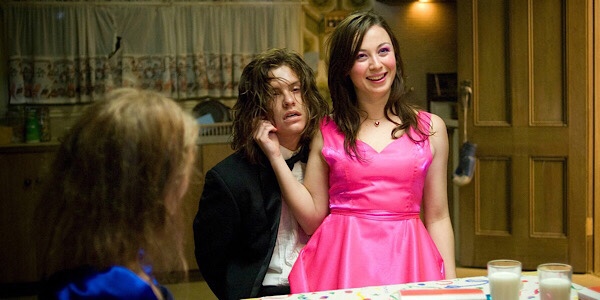
Sean Byrne‘s 2009 directorial debut The Loved Ones, may just be a low-key stroke of genius in the sense that it is uniquely horrifying, over-the-top, and darkly funny, all while being quite unique. It’s a low-budget, primarily one locale film, which allows its sadistic nature to feel claustrophobic too.
Lola (Robin McLeavy) wants her prom and she wants it her way. With the help of Daddy (John Brumpton), she’ll get it at any cost. However, her dates, including the newest Brent (Xavier Samuel), are in for a terrifying night.
source: Paramount Insurge
When troubled and grieving high schooler Brent is asked by Lola to go to the prom and he declines (to go with girlfriend Holly Victoria Thaine), he’s kidnapped and brought to Lola’s home for their “special” night. This isn’t the first time she’s done this, and what unfolds is darker and sicker than you can imagine. Daddy, along with a lobotomized woman they call Bright Eyes is also there to celebrate the occasion.
What pushes this beyond a usual torture flick is not only the bizarre story, and the totally unhinged Lola, but its witty script. I won’t sugarcoat the fact that this film is utterly disturbing at times, as the acts portrayed are truly deranged. The addition of terrific sound design and a twisted villain in Robin McLeavy makes The Loved Ones nightmare fuel of a different sort.
It’s an impressive debut feature from Sean Byrne that is wildly entertaining even if you’re watching some sequences through splayed hands. The movie also bursts with color and music, showing the contrast between the bloody truth of the circumstances to the sadistic joy Lola gets from it over its brisk but energetic 84-minute runtime.
I like when movies are unexpectedly wicked, but also when they fully commit to their intentions. This was most definitely one of those occasions.
Some of the actions feel a bit repetitive, but through surprising and shocking turns, and dedicated performances The Loved Ones is a darkly comic, twisted horror gem.
Alright, beasties. It’s that Haunt-tobertime of year again. For this edition of Haunt-tober, I’m going to do a post a day but, like a great haul after trick or treating, I’m hoping to mix it up and deliver some surprises. There’ll be reviews, new or old, seen/unseen, TV or film. Depending on my wicked mood, there may also be lists, audio, or video. I hope you’ll enjoy it and remember: stay weird.
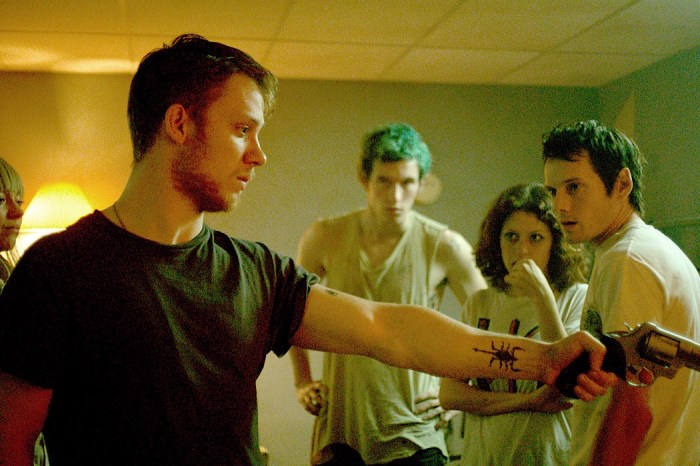
Green Room was one of my favorites of 2015, and it further showed how amazing Anton Yelchin was (RIP) how Imogen Poots is an under-looked talent that is always stellar, and writer/director Jeremy Saulnier is someone who can craft an engaging, gritty piece of work.
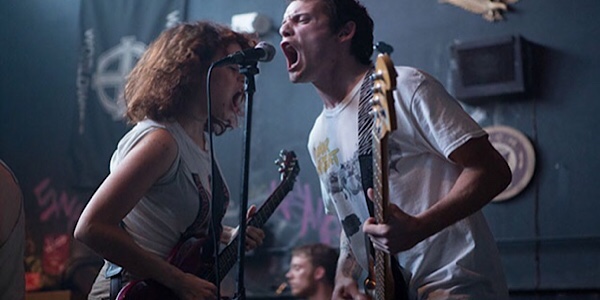
Punk metal band The Ain’t Rights has just got their newest gig, but it isn’t the sort of crowd they want. Bassist Pat (Anton Yelchin) and guitarist Sam (Alia Shawkat), drummer Reece (Joe Cole) and vocalist Tiger (Callum Turner) are in for a challenging night. After a performance, they witness a murder in the green room, and from there theyare thrust into the situation alongside Amber (Imogen Poots) the friend of the victim, trying to escape the clutches of white supremacists.
source: A24
There’s something messy and grungy about Green Room that permeates the graffitied walls and beer-covered floor, beyond the toxicity in the air and the hatred that surrounds the bar full of individuals who will do nothing to keep this crime contained. None worse than Darcy (Patrick Stewart), the especially vicious leader.
That sort of dodgy aesthetic makes each moment feel innately raw, and ultimately, scary. It’s a night of terror and endurance as each member of the band is tested to their limits, with plenty of cringy violence and horrible deaths. There’s also a sense of empowerment for the band, clinging to each decision they make, and hoping they can make it out.
Jeremy Saulnier writes and directs this horror with apt vision and succinct intention. It’s impressive how the tension is racked up and never dulled over the course of its runtime. This was a hard rock no holds barred film with high moshpit-like energy and high stakes. It also proved Patrick Stewart can be sinister. Who knew? Now we do.
There are cinematographic choices that make this limited space feel especially tarnished, each piece of wood worn, each darkened crevice hollow and deep, which makes the setting of Green Room horrifying.
Green Room doesn’t shy away from the violence and shocks, creating some relentlessly disturbing aesthetics. The cast is stellar and the suspense keeps you on the edge of your seat. See it. Now.
Alright, beasties. It’s that time of year again. For this edition of Haunt-tober, I’m going to do a post a day but, like a great haul after trick or treating, I’m hoping to mix it up and deliver some surprises. There’ll be reviews, new or old, seen/unseen, TV or film. Depending on my wicked mood, there may also be lists, audio, or video. I hope you’ll enjoy it and remember: stay weird.
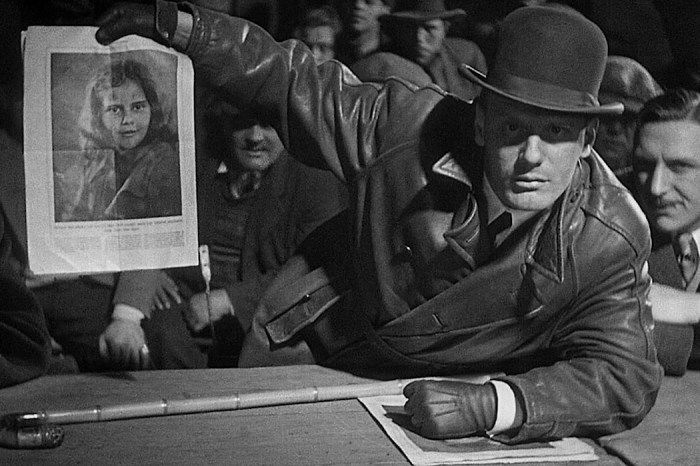
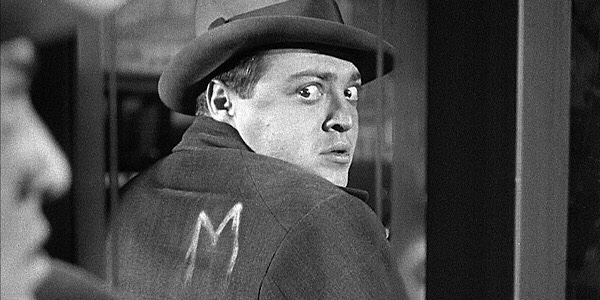
This iconic thriller from Fritz Lang is one that hits not only on the anxiety-driven note of a serial killer in Berlin who preys on children but also the mentality and reaction of the city’s inhabitants as they demand justice and take things into their own hands. The fear in the streets is affecting everyone, police, grieving parents, and even those in the criminal underworld, who can’t run their businesses because of the police force and patrol. Wide-eyed Hans Beckert (Peter Lorre) continues his assault, without being suspected for a time. Lorre’s insane Hans is a standout, from his moments of inability to contain his twisted impulses, to his expressions and body language.
source: Vereinigte Star-Film GmbH
Written by Egon Jacobson and Fritz Lang, Lang crafts a genuinely stunning piece of work that would continue to shape films for years to come. Technically, it is very impressive with the use of long tracking shots and some scenes with little sound, and terrific editing, that makes each moment feel like we’re on the hunt as much as everyone else. Its use of low lighting and shadows gives us what would inspire many noirs of the future. Our first introduction of the identity of the killer comes early and is through his reflection in a window, and his reasoning for being caught is a whistle that Lorre does, and then an “M” is marked on his back. Some of those simple but intentional choices make M a film that impressed and whose impact hasn’t been lessened since its release in 1931.
There’s a menacing unfurling of tension that’s a bold work of expressionism that utilizes every person and object in each scene. It makes its runtime full of taut and edgy moments.
Exceptional performances, packed with social commentary, M is a nail-biting thriller that is brought to life through its expert direction and techniques. A prime example of a must-see classic masterwork ahead of its time.




 Wonderfully Weird & Horrifying