Super Happy Fun Clown: Tragedy Behind the Bloody Smile

There is no doubt that this will invite comparisons to the recent wave of low-budget clown horror. However, Patrick Rea‘s Super Happy Fun Clown isn’t content with simply delivering bloodshed and mayhem. Beneath the greasepaint and carnage lies a surprisingly tragic story that gives the film far more depth than expected. While the kills are plentiful, it’s the character study hiding underneath the bodies that makes this one stand out.

Hope Is Rotting

The story follows Jennifer Sullivan (Jennifer Seward), a woman crushed beneath the expectations of her overbearing mother and the life that never quite turned into what she imagined. Instead of fame and fortune, she’s stuck in a mundane office job and married to an awful husband. Her one genuine outlet is performing as Jenn-O the Clown, bringing joy to children while her own happiness continues to slip away.

At her breaking point, Jennifer combines her obsession with serial killers and clown culture, embracing her desperation for recognition in the worst possible way. If the world won’t notice her talents, she’ll make sure it notices her murders.

Meanwhile, Detectives Marshall and Barnes (Nicole Hall and Matt Leisy) are expecting a routine Halloween night, only to find themselves chasing an increasingly bizarre killing spree.

The supporting cast, particularly the police characters, can feel a little one-note. Thankfully, that’s a minor issue because Super Happy Fun Clown understands exactly whose story it’s telling. This is Jennifer’s descent, and the film remains firmly focused on her unraveling psyche.

That focus works especially well when it comes to Jennifer’s relationship with her mother, who is absolutely relentless in tearing her down. Even moments that should bring Jennifer happiness are met with criticism, making her emotional collapse feel all the more heartbreaking.

Super Happy

For all of its eccentricities and heightened moments, Super Happy Fun Clown remains surprisingly intimate. Even when the story flirts with absurdity, the emotional foundation keeps it grounded.

Horror fans won’t leave disappointed. Once the bloodshed kicks into gear around the midway point, the film delivers plenty of gore and an entertaining variety of kills. Rea clearly isn’t interested in repetition, and some of the film’s nastier moments push the creativity of its carnage even further, including a few particularly unsettling acts of consumption.

The real star, though, is Jennifer Seward. Her performance is wonderfully chaotic, balancing manic energy with genuine vulnerability. This is absolutely her movie, and she carries it with confidence. What surprised me most was how strongly I understood her despite everything she does. There’s an emotional undercurrent running through the film that elevates it beyond a simple slasher, and it’s something I found myself appreciating more and more as the story progressed.

It’s also refreshing to see a female clown killer take center stage in a horror subgenre typically dominated by men.

The film isn’t without its flaws. A few moments, particularly during the final murder sequence set inside a cleverly utilized haunted attraction, feel somewhat disconnected from the rest of the narrative. There are occasional instances where reactions from supporting characters don’t quite land naturally, and the first act suffers from some pacing hiccups. Still, those issues never derail the experience.

Super Happy Fun Clown succeeds because it offers more than shock value. It’s gory, strange, and often darkly funny, but beneath all the chaos is a sad portrait of a woman desperate to be seen. That emotional drive is what makes it linger long after the clown makeup washes away.

NIGHT AFTER NIGHT: This Heart Beats Darkly

There is a subtle strain of violence coursing through Night After Night, one that quietly infects every frame from its opening moments to its final ones. It’s a beating heart in the background, felt more than seen.

There’s no question that this is a film that will test some viewers’ stamina. Its pacing is deliberately patient, often drifting through long stretches of silence and observation. Yet it never feels empty. Visually and narratively, there is always something pulling you forward.

Josh Lobo‘s surreal sci-fi horror film isn’t concerned with delivering easy answers. Instead, it asks viewers to sit with discomfort, uncertainty, and the emotional wreckage left behind by trauma.

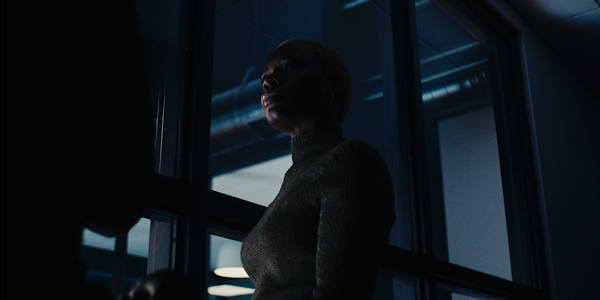
The story begins with Andy (Scott Poythress) and Willis (Johnny Sibilly), two security guards working at a seemingly ordinary university. When Willis grows suspicious of the institution’s founder, Janica Vox (Alexis Louder), and subsequently disappears during a night shift, Andy wants answers.

Daily Dread

That desire for knowing eventually leads into a hidden section of the campus, where an disturbing entity exists. From there, the film transforms into something stranger, darker, and far more intimate.

Night After Night is a mystery at its core, but it continually shifts shape through its various conceits. Even when the film resists explanation, curiosity remains its strongest weapon. Through its stylish temperament, it feels like a blend of psychological horror, neo-noir, body horror, and science fiction. Simon Waskow’s experimental score proves equally effective, creating an unnerving atmosphere.

Lobo crafts a dreamlike world that feels detached from reality, embracing surrealism over exposition. The film often feels Lynchian in spirit, not because it mimics David Lynch’s work, but because it prioritizes emotion over logic. Reality bends. Time fractures. Fantasy and memory begin to overlap until the distinction hardly matters.

The film’s fragmented structure and refusal to provide definitive answers will undoubtedly frustrate some viewers. Yet for the most part, Night After Night succeeds precisely because it remains elusive. What is real? Do the characters even know? There is horror embedded in the workplace itself, even without the voiceless oddity that emerges each night. As a society that is increasingly overworked, exhausted, and disconnected, during a period where reality often feels stranger than fiction, Night After Night speaks volumes.

Even if I can’t fully tell you everything it’s saying.

What We Carry

What I took from it was a story about isolation, guilt, and wounds that refuse to heal. It’s about the damage we inflict on ourselves and the people around us. As more of Andy’s past emerges, the film reveals a deeply alienated man carrying the weight of his own violence and regret. That emotional undercurrent becomes the film’s greatest strength.

There’s a profound sadness running through Night After Night. Nearly every character seems desperate for connection while simultaneously pushing it away. Whether intentional or not, that feeling becomes painfully relatable.

Alexis Louder is exceptional as the cryptic, commanding Janica Vox, bringing an unsettling magnetism to the role. Our two leads disorienting state is often terrifying to watch. Bryce Holden‘s cinematography is equally impressive. The university’s sterile corridors and cavernous concrete spaces become prisons of memory and dread, transforming familiar environments into something quietly terrifying.

Those looking for a conventional horror narrative may find themselves lost within its abstractions. But for audiences willing to embrace ambiguity, Night After Night becomes a rewarding emotional experience, one that haunts long after its melancholy puzzles begin to fade.

Josh Lobo‘s film is ultimately less interested in explaining its mysteries than exploring the scars people carry. Its horror stems not from what lurks in the shadows, but from the painful realization that escaping ourselves may be impossible.

Night After Night is twisty, odd, and unexpectedly moving, a film that burrows beneath the skin and settles somewhere deeper. Its answers remain elusive, but its emotions feel unmistakably real. Long after its mysteries begin to fade, what remains is a lingering ache, a reminder that the most frightening things aren’t hidden in the dark, but carried within us.

Or maybe, it’s both.