NIGHT AFTER NIGHT: This Heart Beats Darkly

There is a subtle strain of violence coursing through Night After Night, one that quietly infects every frame from its opening moments to its final ones. It’s a beating heart in the background, felt more than seen.

There’s no question that this is a film that will test some viewers’ stamina. Its pacing is deliberately patient, often drifting through long stretches of silence and observation. Yet it never feels empty. Visually and narratively, there is always something pulling you forward.

Josh Lobo‘s surreal sci-fi horror film isn’t concerned with delivering easy answers. Instead, it asks viewers to sit with discomfort, uncertainty, and the emotional wreckage left behind by trauma.

The story begins with Andy (Scott Poythress) and Willis (Johnny Sibilly), two security guards working at a seemingly ordinary university. When Willis grows suspicious of the institution’s founder, Janica Vox (Alexis Louder), and subsequently disappears during a night shift, Andy wants answers.

Daily Dread

That desire for knowing eventually leads into a hidden section of the campus, where an disturbing entity exists. From there, the film transforms into something stranger, darker, and far more intimate.

Night After Night is a mystery at its core, but it continually shifts shape through its various conceits. Even when the film resists explanation, curiosity remains its strongest weapon. Through its stylish temperament, it feels like a blend of psychological horror, neo-noir, body horror, and science fiction. Simon Waskow’s experimental score proves equally effective, creating an unnerving atmosphere.

Lobo crafts a dreamlike world that feels detached from reality, embracing surrealism over exposition. The film often feels Lynchian in spirit, not because it mimics David Lynch’s work, but because it prioritizes emotion over logic. Reality bends. Time fractures. Fantasy and memory begin to overlap until the distinction hardly matters.

The film’s fragmented structure and refusal to provide definitive answers will undoubtedly frustrate some viewers. Yet for the most part, Night After Night succeeds precisely because it remains elusive. What is real? Do the characters even know? There is horror embedded in the workplace itself, even without the voiceless oddity that emerges each night. As a society that is increasingly overworked, exhausted, and disconnected, during a period where reality often feels stranger than fiction, Night After Night speaks volumes.

Even if I can’t fully tell you everything it’s saying.

What We Carry

What I took from it was a story about isolation, guilt, and wounds that refuse to heal. It’s about the damage we inflict on ourselves and the people around us. As more of Andy’s past emerges, the film reveals a deeply alienated man carrying the weight of his own violence and regret. That emotional undercurrent becomes the film’s greatest strength.

There’s a profound sadness running through Night After Night. Nearly every character seems desperate for connection while simultaneously pushing it away. Whether intentional or not, that feeling becomes painfully relatable.

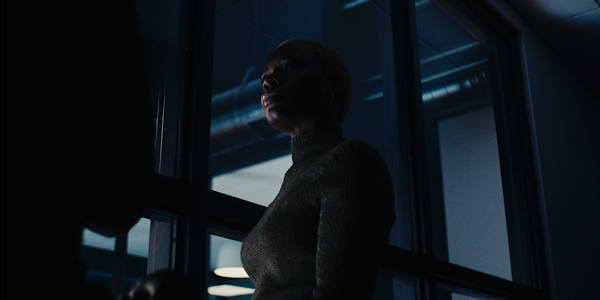
Alexis Louder is exceptional as the cryptic, commanding Janica Vox, bringing an unsettling magnetism to the role. Our two leads disorienting state is often terrifying to watch. Bryce Holden‘s cinematography is equally impressive. The university’s sterile corridors and cavernous concrete spaces become prisons of memory and dread, transforming familiar environments into something quietly terrifying.
Those looking for a conventional horror narrative may find themselves lost within its abstractions. But for audiences willing to embrace ambiguity, Night After Night becomes a rewarding emotional experience, one that haunts long after its melancholy puzzles begin to fade.

Josh Lobo‘s film is ultimately less interested in explaining its mysteries than exploring the scars people carry. Its horror stems not from what lurks in the shadows, but from the painful realization that escaping ourselves may be impossible.

Night After Night is twisty, odd, and unexpectedly moving, a film that burrows beneath the skin and settles somewhere deeper. Its answers remain elusive, but its emotions feel unmistakably real. Long after its mysteries begin to fade, what remains is a lingering ache, a reminder that the most frightening things aren’t hidden in the dark, but carried within us.

Or maybe, it’s both.
Shining Girls S1: A Dark, Loopy Sci-fi Mystery

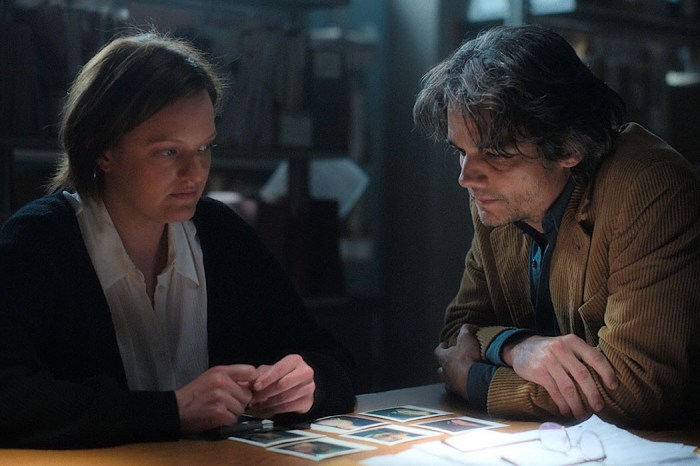
Created by Silka Luisa Shining Girls (based on the book by Lauren Beukes) follows the mind-bending reality of Kirby (Elisabeth Moss) as she tries to navigate life after a devastating near-death attack. This series, which may very well only be one season (or at least I hope) can be head-scratching, nearly anxiety-inducing at times, but remains an intriguing, immaculately performed story that interweaves sci-fi elements with real character-driven drama.

source: AppleTV+

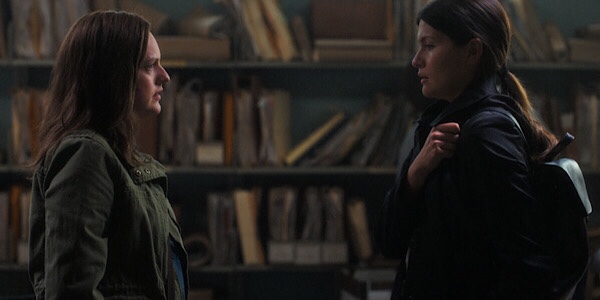
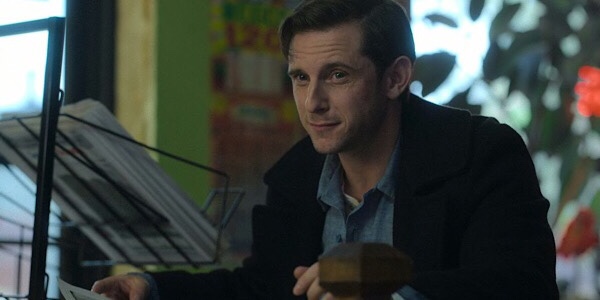
In part, this series focuses on Kirby and her frequently changing reality. She takes notes each day reminding her of her place and where she is within this world as it shifts unexpectedly. One day her desk is moved; another it’s her apartment, her lifestyle, her hair, her pet – you name it. After surviving a nearly fatal attack, she becomes aware of a recent murder that may be connected to her assault. This starts her on an investigative hunt for the truth, and for the assailant, played with expertly portrayed malice, by Jamie Bell as the elusive Harper.

The show takes place in Chicago in the 90s and while there is an element of time travel, it also believably lives in the world of journalism at the Chicago Sun-Times. As someone who wanted to be a reporter, but after her attack worked in the archives, Kirby is a character that embodies a woman you root for. Moss, who has proved she can really portray any role, does it again with a performance that doesn’t leave anything behind.

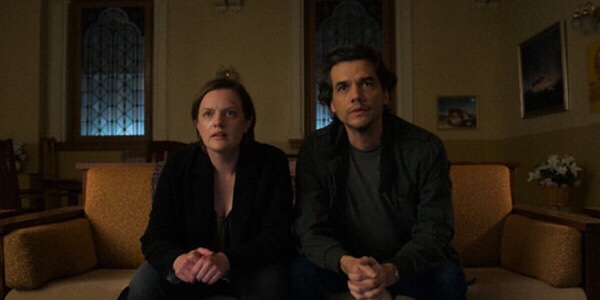
The case grabs the attention of struggling writer, Dan (Wagner Moura) whose career has taken some hits after dealing with addiction. The two form a unique team, discovering many grisly murders that point to a serial killer. Shifting realities often derail Kirby, and she is an unreliable narrator at times, but one who is also committed to figuring out the connections with these deaths. There are a lot of plotlines at work here, one of which is a very enthralling murder mystery and a psychological thriller. Even though we know the who, early on, the why and the telling of the events takes time to be discovered.

Harper’s character is really, truly despicable. He doesn’t generate much empathy; a clear villain. Yet, and kudos to the writers and Bell’s performance, he’s quite curious. What are his motives? Even if we don’t get all of the answers, like the novel delivers more of, we can’t help but wonder about all of the questions.

source: AppleTV+

What’s ultimately frustrating but somehow simultaneously stimulating is the constant differing realities. This is where the science fiction aspect becomes especially prevalent. You feel as if you are with Kirby, understanding her confusion and her relentless perceptions of what her life is. She has all of her memories, but her surroundings and the people involved, including her mother Rachel (Amy Brenneman) and her sometimes husband Marcus (Chris Chalk) make for an overly sympathetic protagonist that truly captures the damage and struggle of someone dealing with a traumatic event. The supporting characters are as equally important as they present a level of both sustainable empathy and disconnect. Shining Girls is nothing if not a vestibule for contemplation. At times, you may feel on par with Kirby, unsure of what you are seeing.

A Mysterious Take On A Serial Killer

While most of the victims are already gone, there is one that can potentially be saved, with a riveting performance by Phillipa Soo as Jin-Sook. The relationship with her and Kirby is one I could have used more of, but it provides a sense (much like her and Dan, but varied) of recluse from her loneliness. The pain and healing of such an event can make someone feel like they are on an island, and we get to see Kirby’s resurgence which is (by its end) is as satisfying as you could hope for.

Shining Girls may not be for everyone. It is an acquired taste because, much like the lead, you’re traversing a difficult situation. The fact that this series personified this so definitively is admirable. Personally, it took me a couple of episodes, but then I was hooked.

There is a lot to potentially spoil, and I won’t. Much like many of this genre, the value is in the experience. It also is a series that earns your approval, your investment, and in its end, proves to be worthy of it. AppleTV+, I feel, has been a streaming service that has very rarely let me down. I’ve had several I’ve written about admirably here and on my other site (filminquiry.com) and some I haven’t but appreciated all the same.

source: AppleTV+

Shining Girls mixes investigative mystery with science fiction in a way that never feels exploitative and it gives a voice to trauma and an inventive story to boot; an avenue for imaginative storytelling that still somehow feels grounded. Come for the intrigue, stay for the performances; everyone is at the top of their game, and Elisabeth Moss, again, proves she is one of the best actresses on television.

A perplexing series with no shortage of hard-to-watch moments, Shining Girls is an enthralling, bold tale.

I dug it.

Shining Girls Season One is available to stream on AppleTV+.